Aerospace LLM Evaluation with Domain Expert Scoring
Combine automated checks with expert scoring, traceable tests, and release gates to evaluate aerospace LLMs and prevent unsafe deployments.

In this article
- Build a Risk-Based Rubric and Traceable Tests
- Set Scoring Criteria and Blocking Defects
- Build Approved Reference Cases
- Trace Requirements Through Release Decisions
- Combine Automated Checks and Expert Review
- Choose Evaluation Methods by Task
- Calibrate Automated Judges Against Expert Scores
- Resolve High-Risk and Disputed Cases
- Test Failure Cases and Apply Release Gates
- Test Source Gaps, Conflicts, and Numerical Errors
- Test Components and End-to-End Workflows
- Record Release Decisions and Required Fixes
- Maintain Evaluation After Release
- Monitor Production and Retest Changes
- Support Evaluation with Ryshe
- Conclusion: Follow an Evidence-Based Release Process
- TSL: Curating Evaluation Prompts, Defining Scoring Criteria + Designing LLM Judge Prompt Template
- FAQs
- How do I set risk-based scoring thresholds?
- How many expert-reviewed cases do I need?
- Which changes require a full reevaluation?
- Frequently asked questions
- How do I set risk-based scoring thresholds?
- How many expert-reviewed cases do I need?
- Which changes require a full reevaluation?
Originally published October 26, 2026.
I wouldn’t release an aerospace LLM based on one accuracy score. I’d combine automated tests with expert scoring, set release rules before testing, and require a named approver to sign off.
Here’s the process I’d follow:
- Define the risks: Set the intended use, assign owners, and score defects across four levels: Critical, High, Medium, and Low.
- Keep tests traceable: Link each case to approved sources, aircraft configuration, model version, and reviewer decisions.
- Check the judges: Compare automated scores with independent expert reviews, paying close attention to unsafe answers marked as passes.
- Test failure paths: Check source conflicts, calculation errors, prompt injection, access controls, and expert handoffs.
- Gate and monitor releases: Fix blocking defects, retest changes, and retain review records after deployment.
My rule: no release with unresolved blocking defects. Audit tools can help preserve records, but they don’t replace engineering judgment or establish regulatory compliance documentation.
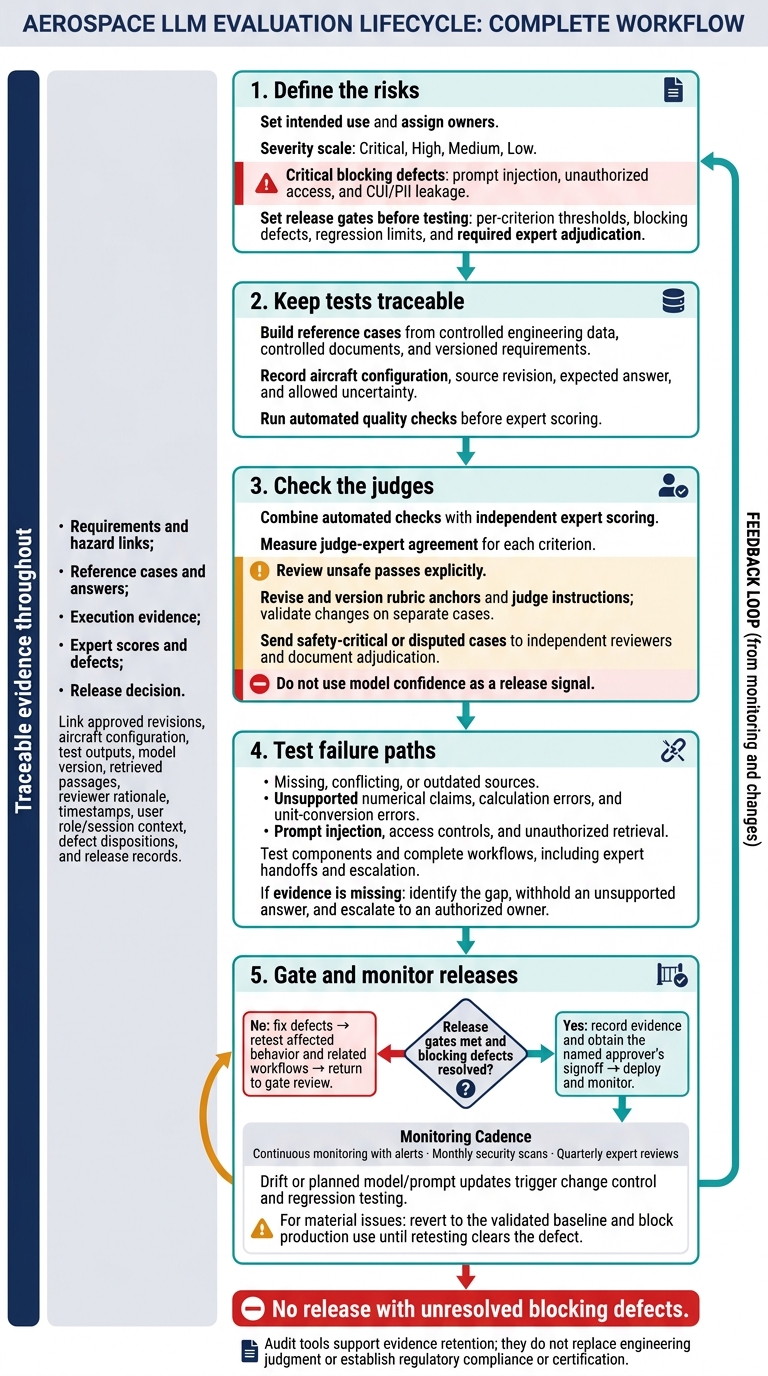
Aerospace LLM Evaluation: From Risk to Release
Build a Risk-Based Rubric and Traceable Tests
Set Scoring Criteria and Blocking Defects
Turn each intended task, hazard, and approved procedure into a measurable check. Use a shared data dictionary and a four-level severity scale: Critical, High, Medium, Low.[3][1] Treat prompt injection, unauthorized access, and CUI/PII leakage as Critical blocking defects.[1]
Build Approved Reference Cases
Create reference cases from controlled engineering data, controlled documents, and versioned requirements. For each case, record the aircraft configuration, source revision, expected answer, and allowed uncertainty. When a case depends on configuration data, connect sources from PLM, ERP, and MES to keep that configuration accurate and current.[3]
Run automated quality checks before expert scoring to keep the reference set consistent.[3] These cases form the baseline for both automated checks and expert scoring.
Trace Requirements Through Release Decisions
Keep the following artifacts to support release decisions when automated checks and expert judgments disagree.[2][3]
| Artifact | Evidence to retain |
|---|---|
| Requirements and hazard links | Approved requirement and hazard-register revisions |
| Reference cases and answers | Test-set revision, source-document revisions, aircraft configuration, expected answer, and allowed uncertainty |
| Execution evidence | Test case, output, model version, retrieved passages, reviewer rationale, timestamps, and user role and session context |
| Expert scores and defects | Expert score, rubric revision, assessment revision, and defect disposition |
| Release decision | Release baseline and decision record |
Use this traceability record in the next review step to compare automated checks with expert scores and calibrate automated judges.
Combine Automated Checks and Expert Review
Choose Evaluation Methods by Task
Use the traceability record from the prior section to match each task to the right evaluator. Automate repeatable checks, use experts for technical interpretation, and send safety-critical disputes to panels. Report each criterion’s score alongside its check result, source passage, or reviewer rationale.
Score each criterion against its own evidence.
| Method | Suitable uses | Strengths | Limits | Evidence strength |
|---|---|---|---|---|
| Deterministic checks | Citation existence, USML/CCL compliance scanning | Repeatable results | Cannot establish contextual compliance | High for binary checks |
| Retrieval metrics | Relevant source coverage | Measures retrieval accuracy | Does not verify technical truth | Requires source links |
| LLM judge scoring | Rubric-based draft scoring | Scalable | May miss technical errors | Requires calibration |
| Individual experts | Calculations, technical summary review | Technical interpretation | Reviewer variability | High with rationale |
| Expert panels | Safety-critical adjudication | Documented consensus | Resource-intensive | Supports release gates |
A citation can exist without supporting the claim. For retrieval, compare retrieval methods and score source coverage separately from answer support. For technical summaries, have experts check the interpretation and any omitted conditions. Keep calculation evidence alongside the score.
Calibrate Automated Judges Against Expert Scores
Have experts independently score shared calibration cases before adjudication. Then measure judge-expert agreement for each criterion. Review unsafe passes explicitly: overall agreement can hide critical misses.
Review disagreements, then revise and version the rubric anchors and judge instructions. Test those changes on separate validation cases before automated scores influence release gates. Keep calibration and validation results separate so performance on cases used to tune the judge is distinct from performance on other cases.
Resolve High-Risk and Disputed Cases
Send ambiguous, novel, low-confidence, and high-risk outputs to qualified experts. Do not use model confidence as a release signal. For safety-critical or disputed cases, use independent reviewers and document the adjudication. Require brief justifications that name the source passage or technical error.
Keep unresolved technical concerns open for the designated release owner rather than counting them as a pass. Send unresolved cases into failure-case testing and release-gate review.
Test Failure Cases and Apply Release Gates
Test Source Gaps, Conflicts, and Numerical Errors
Use unresolved expert-review cases to test where the model is most likely to fail.
Build tests around missing, conflicting, or outdated sources, unsupported numerical claims, and unit-conversion errors. Vary both prompts and retrieval context to check the issues experts are most likely to reject: weak sourcing, ambiguity, and faulty arithmetic. Check tolerances and unit conversions. When the model abstains, it must identify the missing evidence and escalate to an authorized owner - not invent an answer.
Hypothetical conflict test: Retrieved documents provide conflicting values for the same assembly, and the approved revision cannot be established. The expected response identifies the conflict, withholds a recommendation, and requests clarification from the responsible engineering authority. Choosing a value without verified revision control fails the test.
After testing individual failure cases, test the full workflow, including permissions and handoffs.
Test Components and End-to-End Workflows
Test parsing, retrieval, calculations, and tool calls separately. Then run the complete workflow through access controls, human handoffs, and escalation.
Include prompt injection hidden in source documents, encoded prompt-injection payloads, and attempts to retrieve CUI or ITAR-controlled data without authorization. Verify access restrictions at retrieval and tool boundaries, not just in the final response. These checks catch failures that appear only when retrieval, tools, and access controls interact.
Record Release Decisions and Required Fixes
Set release gates before testing. Define per-criterion thresholds, blocking defects, regression limits, and required expert adjudication. Apply the release gate only after failure tests and retests meet the rubric thresholds.
Review every new failure, complete the required corrective actions, and retest both the affected behavior and related workflows. Close each defect before signoff, and name an approver for the final release decision.
Record the gate outcome, tested versions, expert findings, defect closures, retest evidence, and the accountable approver’s signoff.
Maintain Evaluation After Release
Monitor Production and Retest Changes
Evaluation doesn’t stop at release. Keep the same traceability after deployment that supported the release decision. Monitor continuously with alerts, run monthly security scans, and conduct quarterly expert reviews.[1][3] Store monitoring records inside the approved security boundary.
When monitoring detects drift - or a model or prompt update is planned - treat it as a new evaluation event. Put production changes through change control, rerun regression tests, preserve the approved baseline, and link results to the new version before approving it for production.[3]
Use red-team and production findings to build a prioritized fix list and add edge cases to the same expert-scored rubric. For material issues, revert to the validated baseline and block production use until retesting clears the defect.[1]
Support Evaluation with Ryshe
Production monitoring needs tools that preserve evidence and support audits.
Ryshe can support aerospace AI delivery through integrations, validation workflows, audit trails, and deployment documentation. When configured appropriately, Quanta can enforce policy and preserve append-only audit records for governance.[4] These controls do not replace domain expert approval, establish regulatory compliance, or confer certification.
Conclusion: Follow an Evidence-Based Release Process
Keep post-release evaluation in the same evidence chain: monitor, retest, document, and block redeployment until expert review clears the change.
TSL: Curating Evaluation Prompts, Defining Scoring Criteria + Designing LLM Judge Prompt Template
FAQs
How do I set risk-based scoring thresholds?
During discovery, work with your team to define success criteria, dependencies, and risk tolerances. Align thresholds with established security and governance frameworks, such as NIST AI RMF or ISO 42001, to support compliance.
Use these thresholds as automated gates that approve, flag, or route outputs based on specific requirements you can audit. During continuous evaluation, combine batch testing, shadow runs, and expert human review to fine-tune thresholds before releasing to production.
How many expert-reviewed cases do I need?
The article doesn’t set a fixed number of expert-reviewed cases. Instead, it recommends a 6–8-week controlled pilot for one program or product line, with your team reviewing every AI output. Expand only after you’ve verified accuracy and compliance.
Which changes require a full reevaluation?
Changes to requirements or project scope in aerospace AI development call for a full reevaluation. Even small changes can affect compliance or performance under requirements such as ITAR, CUI, or AS9100.
Scope changes also need formal re-estimation to check alignment with existing safety and governance frameworks. A consistent, documented process helps prevent drift and keeps each update traceable and compliant.
Frequently asked questions
How do I set risk-based scoring thresholds?
During discovery, work with your team to define success criteria, dependencies, and risk tolerances. Align thresholds with established security and governance frameworks, such as NIST AI RMF or ISO 42001, to support compliance. Use these thresholds as automated gates that approve, flag, or route outputs based on specific requirements you can audit. During continuous evaluation, combine batch testing, shadow runs, and expert human review to fine-tune thresholds before releasing to production.
How many expert-reviewed cases do I need?
The article doesn’t set a fixed number of expert-reviewed cases. Instead, it recommends a 6–8-week controlled pilot for one program or product line, with your team reviewing every AI output. Expand only after you’ve verified accuracy and compliance.
Which changes require a full reevaluation?
Changes to requirements or project scope in aerospace AI development call for a full reevaluation. Even small changes can affect compliance or performance under requirements such as ITAR, CUI, or AS9100. Scope changes also need formal re-estimation to check alignment with existing safety and governance frameworks. A consistent, documented process helps prevent drift and keeps each update traceable and compliant.