Data Integration Strategy Built Around Goals
A data integration strategy that ties systems, governance, and security to business goals, and shows where deep integration is worth the cost.
A good data integration strategy doesn't start with a connector catalog. It starts with a choice about which records must mean the same thing, in every system, at the moment someone acts on them.
Why Most Enterprise Data Never Gets Used
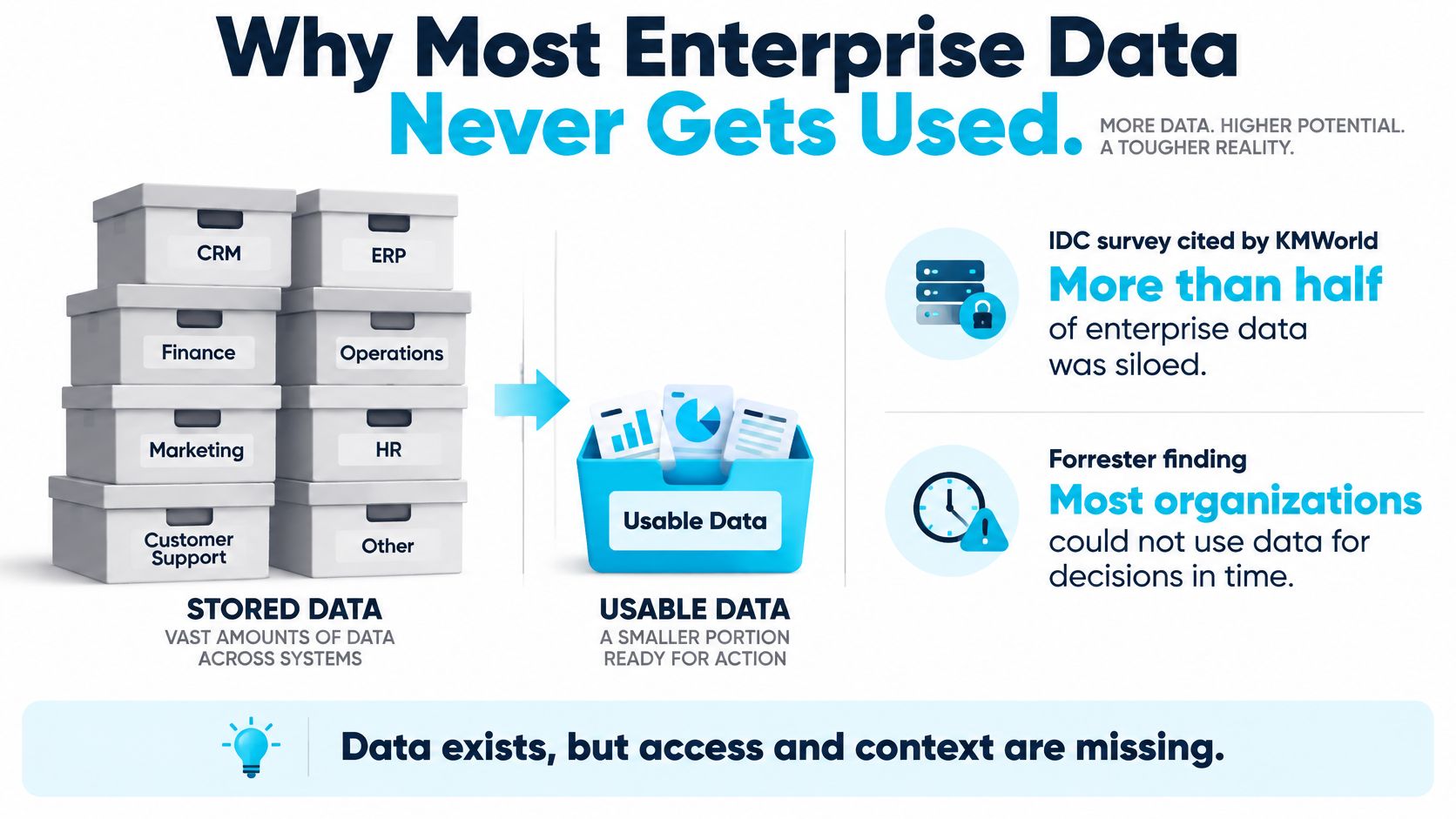
An IDC survey cited by KMWorld found that more than half of enterprise data was siloed, and a Forrester finding in the same report said only 1% of enterprise data was used, partly because much of it was inaccessible. That's the problem a data integration strategy has to solve. It isn't that companies lack data. It's that the data sits in separate stores, with separate definitions, and no one can use it across teams without manual work.
Say a manufacturer runs project controls, procurement, an ERP, a CRM, engineering tools, a quality system, and a document library. Each one works on its own. A buyer retypes a purchase order, quality can't trace an inspection to the released revision, and finance builds a report from a spreadsheet export that's already stale. The systems aren't broken. They just never agreed on what a part, a project, or a supplier is.
Think of neighboring workshops that already make good parts. You don't need to move every machine into one room. You need to decide which parts must fit together, and who checks the fit.
What the Strategy Actually Decides
A data integration strategy is the set of choices that makes a chosen set of records usable across teams. It covers connectivity, common definitions, metadata, access controls, data quality, ownership, and operating processes together, not just interfaces.
Design for outcomes you can measure:
- Less manual re-entry: An order entered once, used everywhere.
- Faster reporting: Numbers drawn from governed products, not exports.
- Traceable inspections: A result tied to a source file and a part revision.
- Reliable automation: Workflows and AI features that don't invent their own meaning for a part or supplier.
The build order matters. Decide which workflows deserve a shared state, which entities get one meaning, which movement pattern fits each workload, who owns exceptions, how classification travels with the data, and what ships first. Software selection comes after those answers, not before them.
Where Deep Integration Is Worth the Cost
Connecting everything sounds thorough. It's often just expensive. In the 2025 Industry 5.0 Barometer covering France and Germany, 43% of respondents said their systems could exchange data but that doing so remained complex and inefficient. A working connection isn't the same as usable integration.
Start with this filter. Deep integration means one shared, current state, where two systems can't be allowed to disagree. A lighter path means a governed snapshot, a scheduled replica, or a human-reviewed document flow that's good enough for the decision at hand.
| Workflow | Integrate deeply when | Lighter path | Prove it with |
|---|---|---|---|
| Purchase order or receipt | ERP and procurement must show the same open, received, and invoiced state | Do not lighten a shared transaction | Zero manual re-entry of the order |
| Safety or compliance record | An audit must point to one authoritative state | Snapshot plus human review only if same-day coherence is not required | Traceable record from source to report |
| Production or quality decision | A wrong or late value stops a line or ships a bad part | Governed replica when the source changes slowly | Fewer holds caused by stale data |
| Engineering change | Downstream buyers must see the released revision, not a draft | Publish on release rather than sync every edit | One released revision in every consumer |
| Document workflow | Extracted fields drive a payment, submittal, or approval | Human-reviewed routing when meaning is ambiguous | Cycle time cut without unchecked auto-posting |
| Analytics or AI feature | A decision or model needs current governed fields | Scheduled snapshot of approved fields only | Faster decision, not more connected apps |
How to Score a Workflow
Take one workflow you already have and score it on six questions. How ambiguous is the meaning across systems? How often does the record change? What happens when a sync fails or lands late? How fresh does the value need to be when someone acts? Who owns the record today? If a bad sync posts, can you reverse it?
A purchase order scores high on failure impact and low on reversibility, so it earns a shared state. Draft engineering edits change constantly, but nobody should build from them, so publishing on release is cheaper and safer. An inspection summary that's reviewed each morning doesn't need minute-level freshness, even if the tool can stream it.
Scoring rule: If two systems disagreeing would change a payment, a shipment, a safety decision, or an audit answer, integrate deeply. Otherwise, start lighter and earn the deeper build.
Watch the AI trap here. A model fed from a system nobody has declared authoritative will learn the mess at scale, and governance tooling that's disconnected from the AI platform can't stop it. Decide which source wins before you automate anything on top of it.
A One-Week Exercise
List your top ten cross-system workflows. Mark three for a shared state. Park the rest as snapshots or replicas until those three have a named owner and a freshness target. Build in observability, reconciliation, rollback, and exception queues from the start, and judge the result by fewer operational errors and faster decisions, not by how many applications you connected.
A Shared Meaning Before Any Connector
Once you've picked the workflows, define the language before you move any data. NIST's Big Data Interoperability Framework names interoperability, portability, reusability, and extensibility as core requirements, and describes integration as a semantically integrated data space where silos can be accessed consistently. In plain terms, transport is the easy part. Shared meaning is the work.
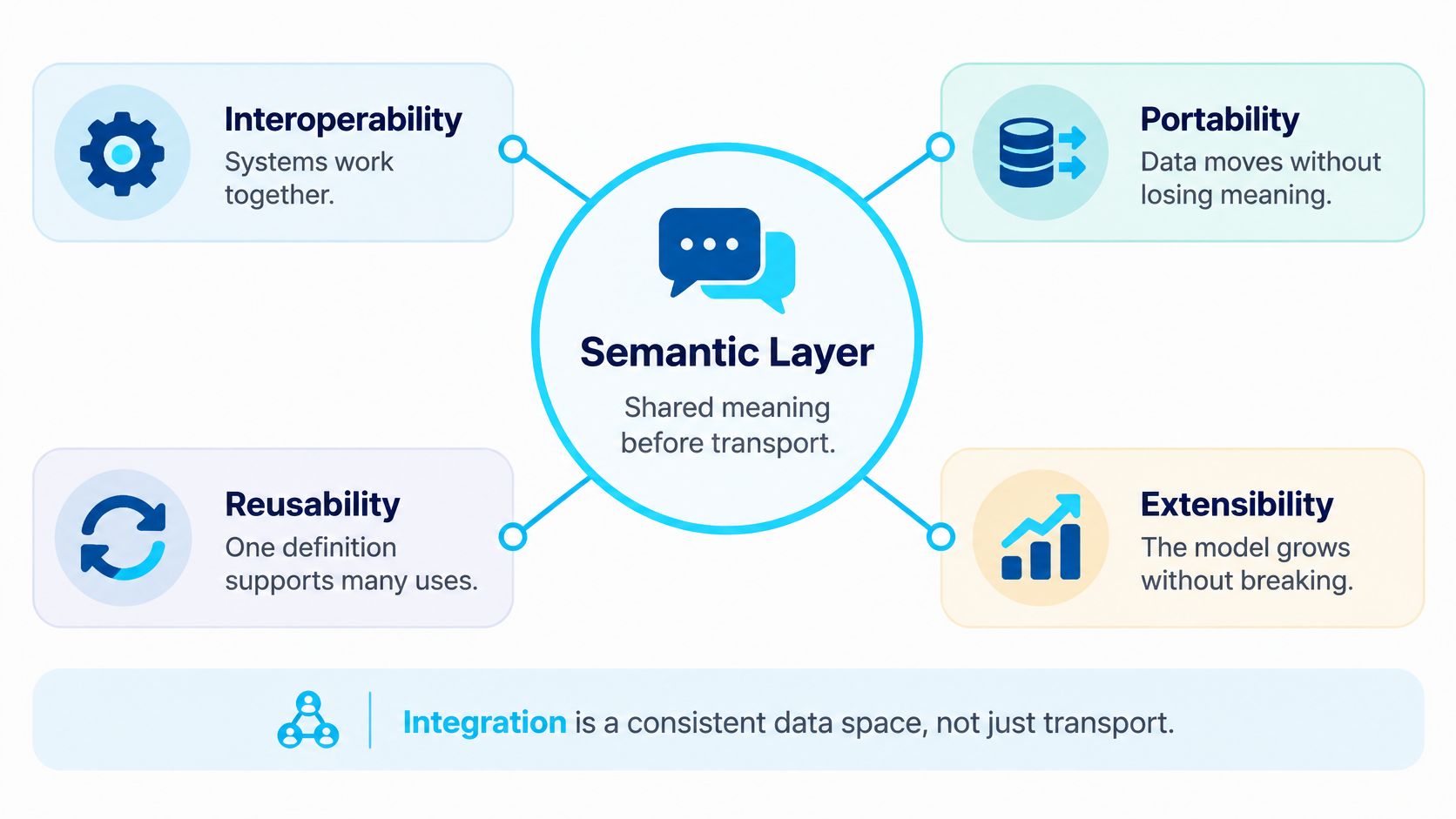
A semantic layer is a vendor-neutral set of canonical entities. For most industrial work, seven cover the bulk of it: project, supplier, purchase order, asset, part, document, and inspection result. For each one, record a stable business meaning, a shared identifier, data types, units, code sets, an owner, and lineage.
| Entity | Shared attributes | Source systems | Typical owner |
|---|---|---|---|
| Project | Project ID, status code set, owner, lineage | Project controls, ERP | Project owner |
| Supplier | Supplier ID, legal name, status code set, owner | ERP, procurement | Procurement lead |
| Purchase order | Order ID, quantity unit, open or received or invoiced status | ERP, procurement | Procurement lead |
| Asset | Asset ID, location, status code set, owner | ERP, maintenance | Asset owner |
| Part | Part number, revision, unit of measure, release status | Engineering, ERP, manufacturing | Engineering owner |
| Document | Document ID, revision, classification, approval status | Document management, engineering | Document steward |
| Inspection result | Result ID, part revision, measured value, unit, pass or fail code | Coordinate-measuring system, quality | Quality owner |
Keep the Model Small and Enforced
Don't copy every source column into the canonical model. Each source system, whether ERP, CRM, engineering, document management, or manufacturing, maps to the governed contract once. A new dashboard then reads the contract instead of inventing a private mapping. That's what cuts point-to-point coupling.
The model also has to hold more than tidy rows. Industrial data includes unstructured text, documents, graphs, geospatial and temporal data, multimedia, and simulation files. The contract approach still works. The document entity carries the ID, revision, and approval status, while the file itself lands unchanged alongside it.
Four controls keep mappings from drifting:
- Version everything: Keep schemas and mapping specifications in source control.
- Name an owner: Assign a data-product owner for each entity.
- Validate at the door: Reject missing required fields and mismatched units at ingestion.
- Publish compatibility rules: State what a schema change may and may not break before it ships.
Require APIs, events, and batch files to expose the same canonical identifiers and metadata. Then a quality model and a finance report cannot treat two part numbers as the same part. Start small: one workflow, five to ten entities, and a written list of the conflicting definitions you're retiring.
Pipeline Patterns for Uneven Workloads
With meaning settled, you can choose how data moves. The mistake is picking one pattern for everything. NIST's big data reference architecture notes that systems may need to support slow, bursty, and high-throughput transmission, alongside multiple content types and schemas spanning similar sources. A plant and a project office generate all three behaviors on the same day, so the design is hybrid on purpose.
| Pattern | Use it for | Land first | Watch |
|---|---|---|---|
| Change data capture or events | Operational facts that go stale in minutes, such as order status or a released change | Immutable raw event, then a validated product | End-to-end latency and duplicate rate |
| Scheduled incremental extract | Systems with no trustworthy event interface | Raw extract with source offsets and hashes | Freshness, completeness, schema drift |
| Batch | Large documents, historical ERP loads, simulation files, regulated archives | Immutable raw files, then modeled products | Reconciliation totals and quarantine volume |
What Every Path Has in Common
Whichever pattern fits, land immutable raw data first. Then build a validated, modeled data product that carries timestamps, source offsets, record hashes, and reconciliation totals. If a transformation turns out to be wrong, you can replay from raw instead of begging the source system for a second extract.
Recoverability comes from a short list of controls:
- Idempotent writes: Running a load twice produces the same result, not duplicates.
- Replayable ingestion: Any window of data can be reprocessed on demand.
- Dead-letter handling: Records that can't be processed land somewhere visible, not in a log nobody reads.
- Quarantine: Invalid records wait for a human decision instead of failing the whole load.
- Monitoring: Freshness, completeness, duplicate rate, schema drift, and end-to-end latency, each with an alert threshold.
Portability Is a Design Choice
NIST's reference architecture is technology- and infrastructure-agnostic, and that principle pays off in practice. If your contracts are stable, you can change a storage layer, swap an application, or replace an AI service across Azure, Microsoft 365, ERP, CRM, engineering, and production systems without rewriting every consumer. Failure recovery, audit evidence, and controlled migration all get easier when the contract outlives the tool.
Our deeper guidance on data pipelines for AI workloads covers how these patterns feed production models. For pattern selection itself, keep one rule in view.
Pick the slowest pattern that still meets the latency you wrote down. Don't add a stream just because the tool supports one.
Streaming everything buys you operational cost, ordering headaches, and duplicate handling for data that a nightly load would have served fine. Match the pattern to the decision, and the pipelines stay boring in the best way.
Who Owns Data After the Pipes Exist
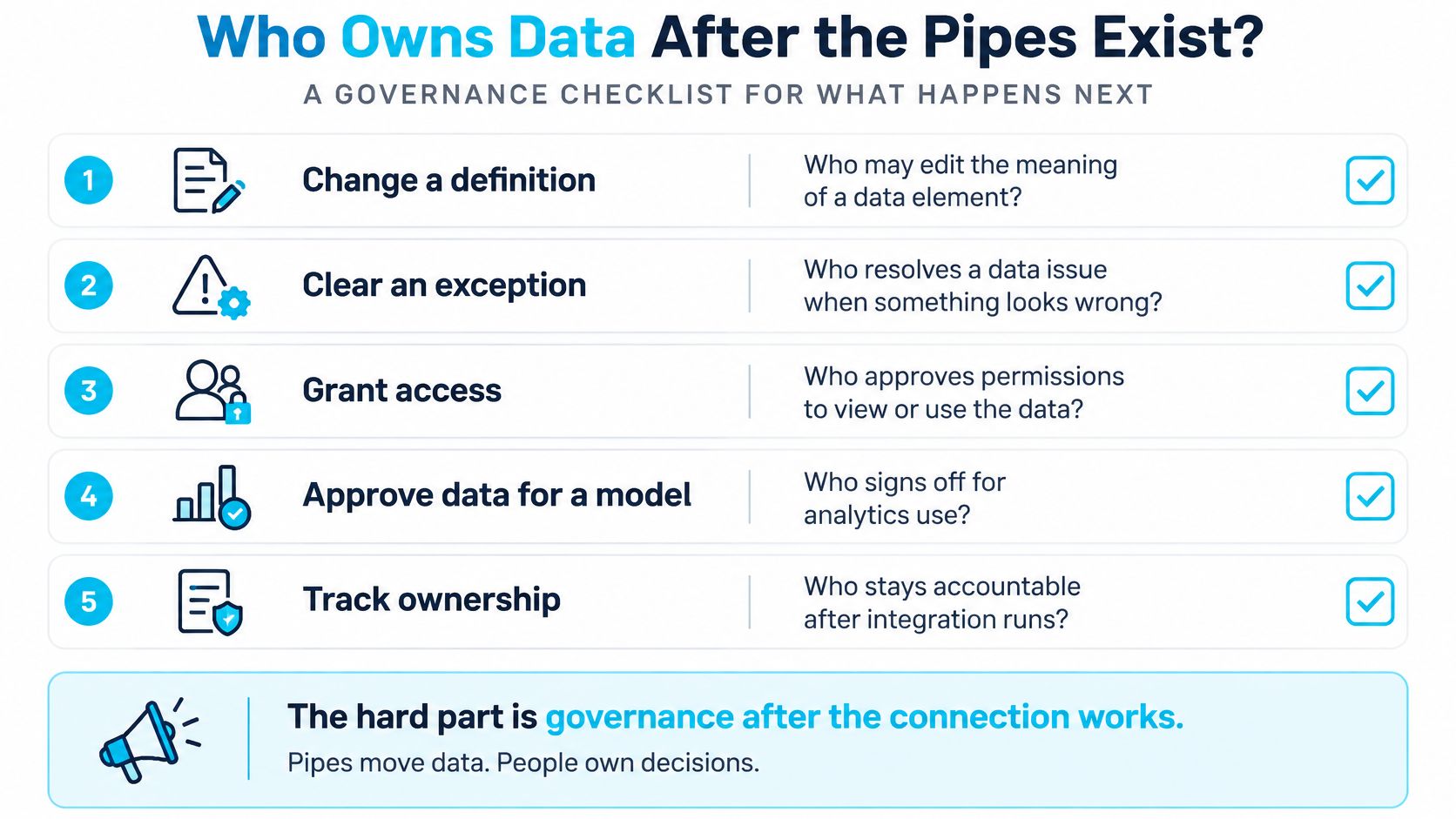
Pipelines go live, dashboards light up, and then a definition changes in the ERP. Who may approve it? Who clears the quarantined records? Who grants a new team access, and who signs off before a model reads the product? If nobody can answer, the integration is already decaying.
This gap is common. EY's 2025 Europe West survey found that only 18% of organizations had clearly defined data-governance responsibilities, while just 10% had systematic processes for updating AI models. The operating problem sits underneath those figures: ownership has to be assigned before the first incident, because a dashboard cannot decide whose definition wins.
A Product and Process Model
Skip the abstract debate about central versus local. Assign decision rights per entity, then connect only where two systems must agree on one shared state, such as released revision, supplier status, or inspection result. A domain owner owns the meaning of each canonical entity. A named steward works the exception queue. The platform team owns pipelines, replay, and freshness, while business meaning stays with the domain. That split matters in industrial firms, where the same part or supplier can have different authoritative systems and regulatory obligations.
| Model | Who owns meaning | Who runs pipelines | Best when | Operating measure |
|---|---|---|---|---|
| Centralized | One data office | Central platform team | Few domains and strict regulatory consistency | Share of critical fields with a named owner |
| Federated | Each domain | Shared platform standards, domain implementation | Many business units with different sources | Issue-resolution time inside the domain |
| Hybrid | Domain owners on a shared contract | Central platform, domain stewards for exceptions | Industrial firms with shared parts and local plants | Lineage coverage and freshness compliance |
Choose with one test: can the domain that feels the bad data also stop it? If quality suffers from bad inspection records but cannot change the validation rule, your model is wrong, whatever it is called.
Governance as Daily Operations
Governance works inside the flow, not in a policy document that nobody opens during an exception. Required-field checks run at ingestion. A full quarantine queue escalates to a named steward. Access decisions tie to role and to ITAR or CUI classification where export-controlled design data is in scope. An AI feature passes a release check before it reads a data product.
Measure four things: issue-resolution time, percentage of critical fields with an owner, lineage coverage, and freshness compliance. If those numbers are visible weekly, governance is operating. Our data governance framework guidance details how to structure those decision rights and exception paths.
Security Controls Built Into the Strategy
Security belongs in the integration contracts, not bolted onto dashboards afterward. If a control only exists in a report, the next consumer bypasses it.
- Classify at creation: Tag every entity and data product as public, internal, confidential, or export-controlled under ITAR or CUI, and carry the tag through every pipeline stage.
- Enforce access at the product: Role-based access on the data product lets shop-floor users see pass or fail results while export-controlled design fields stay masked or withheld.
- Use service identities: Each pipeline job runs with least privilege, reading its source and writing only its target layer. No scheduled load uses a personal login.
- Encrypt and hold the keys: Encrypt data in transit and at rest, with keys under client control so a platform change doesn't expose the raw layer.
- Separate plant and cloud: Route plant-to-cloud traffic through a gateway with logged connections, keeping plant networks apart from cloud landing zones.
- Audit beside lineage: Write read, change, and release events to the audit trail so an auditor sees who touched a record and when.
- Review grants quarterly: Remove access tied to closed projects.
Test each classification level with one restricted-field check before go-live, and record the results as acceptance criteria for the first data product.
An Industrial Strategy in One Worked Case
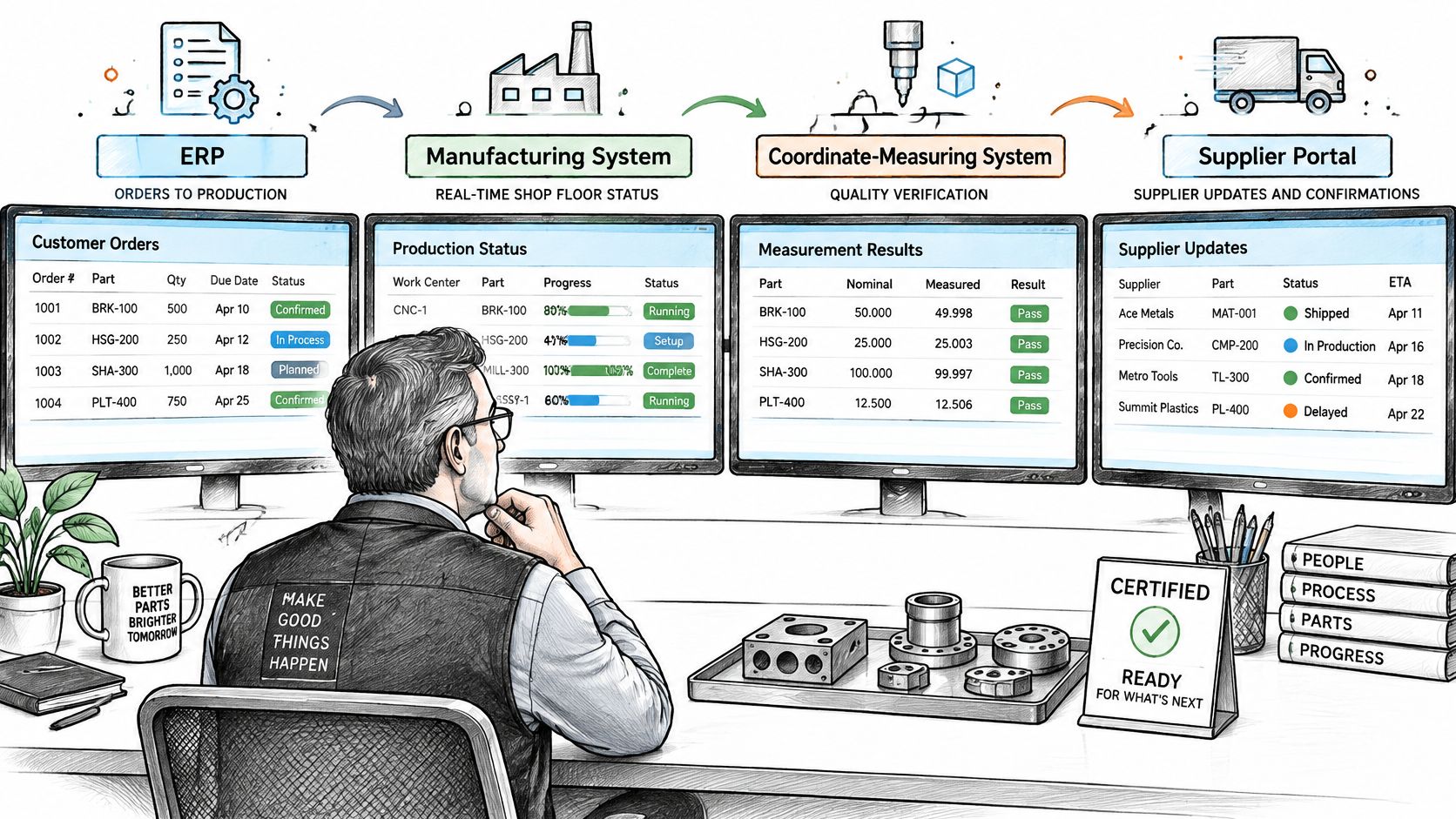
Say a mid-size manufacturer builds certified parts and lives in four systems: an ERP for orders, a manufacturing system for shop-floor status, a coordinate-measuring system for inspection files, and a product-lifecycle system for released revisions. The team applies the priority filter and picks two workflows. Everything else waits.
Workflow One Is Deep
Purchase orders get deep integration. Procurement and the ERP share one order identifier, and status moves by change data capture so open, received, and invoiced states match everywhere. Success is simple and visible: buyers stop retyping orders, and the re-entry errors that came with retyping disappear.
Workflow Two Stays Batch
Inspection results move in batch. Files land overnight because quality review happens in the morning, so streaming would add cost and change nothing. Records with invalid units go to quarantine instead of failing the load. Lineage shows the source file, the part revision, and who released the record, which is what an auditor asks for.
The team deliberately does not integrate draft CAD edits. Only the released revision publishes, so manufacturing never builds from a work in progress. That refusal is the strategy working. Connectivity was available and still wasn't worth it.
The Slice Underneath
The semantic scope stays narrow: part, purchase order, supplier, and inspection result, with one unit of measure and one status code set. Owners are named people. Procurement owns order status exceptions. Quality owns inspection quarantine. The platform team owns replay and freshness. Classification rides on the inspection product, and role-based access lets shop-floor users see results without seeing export-controlled design fields.
Contrast the failed version of the same plant: every system connected, no canonical part, a dashboard nobody trusts because two screens disagree. The difference isn't tooling. It's that the working version integrated in one place, lightly in another, and not at all in a third. You can sketch the same two-workflow slice for your own ERP and quality stack this week.
Start With a Data Health Check
You don't need to buy a platform to begin. Four steps get a team from scattered systems to one trusted product.
- Audit what you have: For the three workflows marked for a shared state, review sources, quality, integration points, and current tools.
- Write the language: Define the canonical entities and identifiers, list the conflicting definitions they retire, and name an owner for each.
- Pick patterns by latency: Choose one pattern per source from the freshness target you already wrote down, and define quarantine, replay, and monitoring before any historical load.
- Ship one product, then stop: Deliver one data product to production with training, documentation, and acceptance criteria. Prove it before expanding.
When internal hiring would stall that work, a proven shape helps. Our data foundation process starts with a Data Health Check that audits sources, quality, integration points, and tooling. A full foundation can run as a 3-week assessment, a 6-week platform build, a 5-week migration and integration, and a 2-week handoff, ending with production validation, team training, and documentation so the platform runs without ongoing dependency on us. Our data readiness checklist helps you scope that first audit.
The decision to make this month is small: which single workflow gets a shared state, an owner, and a freshness target. Everything else waits its turn.
If your ERP, engineering, and quality systems still disagree about the same part, we can help you pick the first workflow worth integrating and build the governed data product behind it, with pipelines and infrastructure-as-code your team owns. Start with a Data Health Check and visit Ryshe to see how an AI-ready data foundation fits your operation.