Data Integration vs Application Integration: Which Fits?
Compare data integration vs application integration by purpose, architecture, use cases and tradeoffs, with a clear guide for choosing in 2026.
The usual advice, use data integration for batch analytics and application integration for real-time workflows, is too blunt to guide a production architecture. Data integration makes information accurate, consistent and available; application integration makes systems exchange events, call functions and complete workflows. Speed alone doesn't tell you which problem you're solving.
For an engineering firm routing submittals or a manufacturer automating procurement, the harder question is what must remain true when systems disagree or a connection fails. Choose the pattern around that business rule, the acceptable delay and the recovery process, not around a preference for real time.
Data Integration vs Application Integration Defined
Data integration combines, transforms and synchronizes information across sources for analytics, reporting, governance and operational use. Application integration coordinates behavior and transactions across software systems.
The distinction concerns responsibility, not whether information moves. Both disciplines transport data and transform payloads. What separates them is the outcome the integration must guarantee.
Data integration vs application integration at a glance
| Criterion | Data integration | Application integration |
|---|---|---|
| Primary objective | Make information accurate, consistent and available | Make systems exchange events, call functions and complete workflows |
| What moves | Records, tables and historical snapshots | Messages, events and business transactions |
| Typical techniques | ETL, ELT, replication, data virtualization | APIs, message queues, event streams, ESB |
| Typical latency | Scheduled delivery within an agreed freshness window, or continuous replication | Interactive response deadlines or asynchronous delivery deadlines |
| Main consumers | Analysts, BI tools, data scientists | Business applications and their users |
| Governance focus | Lineage, quality, shared definitions | Permissions, transaction state, error handling |
| Failure impact | Stale or inconsistent reports | Stalled orders or duplicate transactions |
Latency belongs in the contract, but it isn't a reliable classification test. A continuously updated analytical dataset remains a data-integration responsibility. An application workflow that waits for a supplier acknowledgment remains application integration even when completion isn't immediate.
Why the terminology overlaps
The shared vocabulary has a long history: Coforge's systems-integration history traces ETL-style extraction and loading to the 1980s, enterprise application integration to the 1990s, and ESB and SOA adoption to the 2000s. Today's platforms can package these capabilities together, which makes their commercial labels less useful than their operating responsibilities.
Consider a manufacturing environment. Combining ERP purchase records, production logs and inspection results into a governed analytical model is data integration. Engineers need consistent part identifiers, meaningful timestamps and agreed definitions of rejected material.
Sending an approved purchase order to a supplier, updating the appropriate inventory state and triggering a production workflow is application integration. The workflow must preserve approval rules and distinguish a submitted order from an accepted order.
Separate coherence from completion
A warehouse can contain an accurate copy of a purchase order that the supplier never received. Conversely, the supplier can accept an order while an analytical dashboard still shows an older procurement position. Neither condition proves that the other integration layer works.
This is why ownership shouldn't stop at the connector. Data owners must define what records mean and how discrepancies get reconciled. Application owners must define permitted transitions and what constitutes business completion.
Practical rule: If the question is whether the information is right, start with data integration. If the question is whether the process finished, start with application integration.
That distinction prevents an expensive category error: building another dashboard to solve a broken handoff, or adding another API to solve conflicting business definitions.
Architecture Patterns Behind Each Approach
An ERP extract and an order-submission API may carry similar fields, but they establish different dependencies. Choose the transport after deciding whether the consumer needs a reusable representation of information or an action performed by another system.
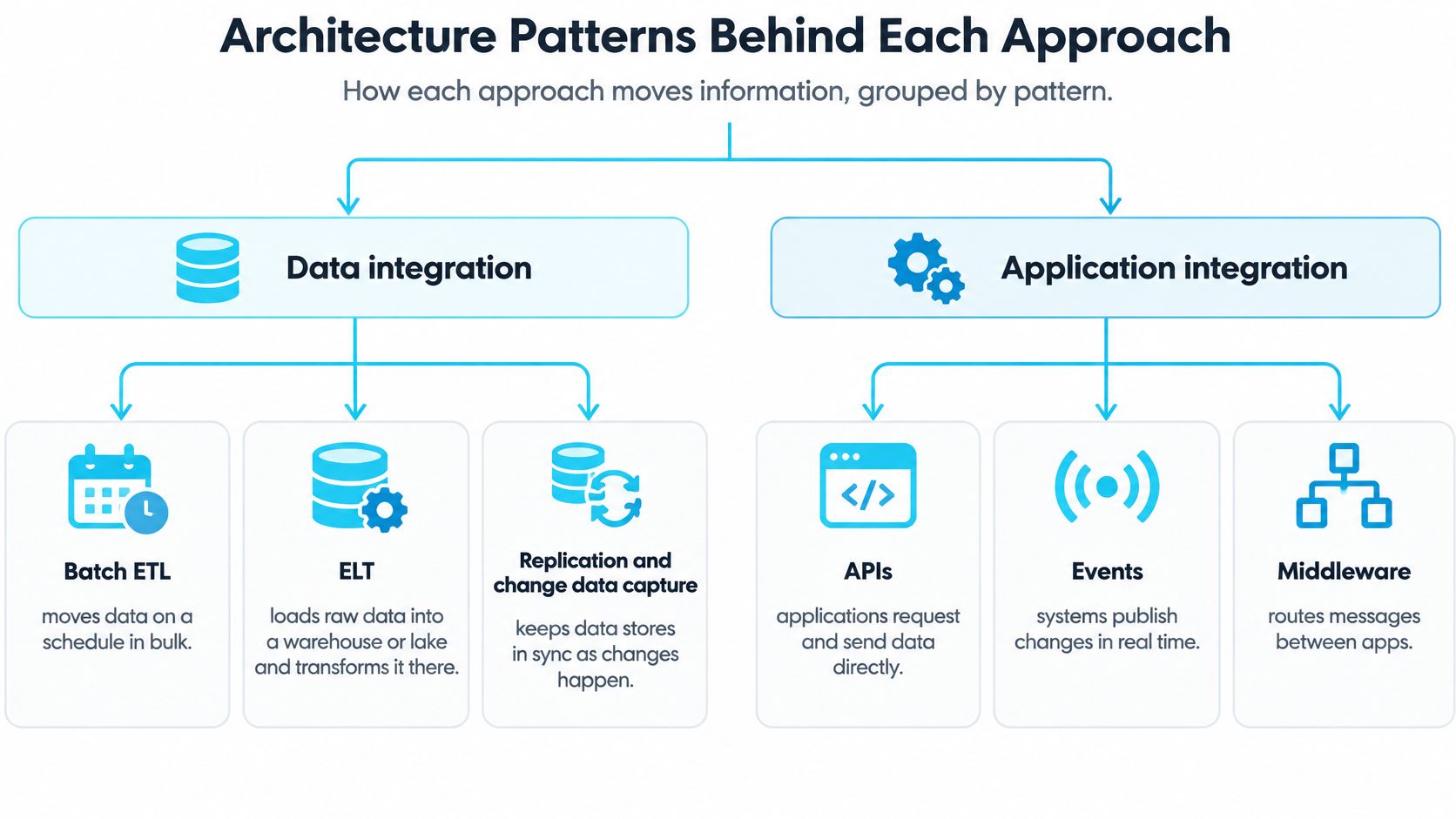
Data-side patterns
Batch ETL extracts records, transforms them outside the destination and loads the prepared result. For example, a finance pipeline can standardize project codes and currencies before publishing close-ready tables.
With ELT, engineers load raw records into a warehouse or lake before applying transformations there. Preserving the original extract lets them rebuild a reporting model when a business definition changes, provided retention and permissions allow it.
Replication and change data capture, or CDC, move changes rather than repeatedly copying the entire source. Say an ERP pipeline collects changed purchase-order rows during a nightly processing window. It must also account for deletions and preserve enough position information to resume safely.
Data virtualization exposes a queryable view across sources without maintaining the same consolidated physical copy. An engineer might query equipment attributes across repositories, but source availability and query load remain part of the design.
Application-side patterns
- Synchronous APIs: A REST or SOAP request asks another application to respond before the caller proceeds. A credit check before order creation fits this pattern when approval requires the current result.
- Asynchronous queues: A producer submits work for later processing. A queue can retain supplier invoices during a receiving-system outage, but operators still need to distinguish pending invoices from failed ones.
- Event streaming: Applications publish changes that subscribers interpret independently. A released production order can notify scheduling and materials services without requiring the producer to call each subscriber directly.
- Middleware: An enterprise service bus or integration platform routes, transforms and monitors messages. It can translate an ERP's purchase-order format into the supplier interface while centralizing connection management.
The ownership difference matters during failure. A materialized data pipeline generally manages a copy, processing position and publication schedule. An application flow manages an operational dependency, even when a queue separates the participating systems.
Virtualization is an important exception because it retains a live query dependency. Likewise, messaging doesn't eliminate application dependencies; it changes when the producer must wait and where unfinished work accumulates. Architecture diagrams should show those dependencies explicitly, including who can restart, replay or reject work.
Performance Targets That Separate the Two
A fast connection isn't necessarily a successful integration. A pipeline can move records quickly while publishing incomplete totals; an API can acknowledge a request promptly while the business transaction remains unfinished.
The NIST Big Data Interoperability Framework identifies latency and interoperability as evaluation dimensions and highlights the need for standardized performance benchmarks. For implementation, translate those broad dimensions into workload-specific acceptance criteria.
Set targets around the consumer
Data teams should measure throughput, processing-window duration, transformation cost, freshness, reconciliation accuracy and restartability. Application teams need end-to-end latency, message or transaction throughput, ordering, delivery reliability, idempotency and recovery time.
The following are contract templates to validate against your service-level agreements, not universal performance standards.
Starting performance targets by integration type
| Metric | Data integration target | Application integration target |
|---|---|---|
| Freshness or latency | Publish validated data before the consumer's decision deadline | Complete interactive calls within the user journey's response budget; define an asynchronous completion deadline |
| Throughput | Records per second and cost per processed volume at peak load | Messages or transactions per second at peak load |
| Reliability | Reconcile record counts and key totals to source at every load | At-least-once delivery with idempotent consumers where replay is acceptable |
| Recovery | Restartable loads that resume from the last checkpoint | Restore processing within the agreed outage budget and clear the backlog |
| Tail behavior | Complete processing within the agreed load window | Measure tail event-processing latency under peak load |
A dashboard's freshness requirement should follow the decision it supports. A production supervisor deciding whether to release work needs a different publication contract from a finance analyst reviewing a closed reporting period. Don't pay for continuous processing unless a consumer can explain what decision would change.
Benchmark failure, not just normal operation
The EIPBench benchmark paper evaluates message throughput across reusable Enterprise Integration Patterns, including routing, transformation and delivery semantics. Its practical implication is to test the integration's actual work, rather than comparing connector labels or empty-message demonstrations.
Use representative payload sizes, transformation complexity and concurrency. Include source throttling, schema changes, connector restarts and downstream outages. Measure whether recovery preserves correctness, not just whether processing resumes.
A bulk-oriented pipeline may miss an interactive transaction deadline because it optimizes aggregate work. Conversely, sending a historical backfill through transactional APIs can consume rate limits needed by operational users.
A performance test should answer both questions: Can the integration keep up, and can operators recover without corrupting business state?
Keep backfill traffic, live traffic and replay traffic distinguishable. Otherwise, a technically successful recovery can overload the same downstream application you're trying to restore.
Use Cases Where Each Approach Fits
Document intake exposes the boundary most clearly. Extracting an invoice's supplier, amount and purchase-order reference creates structured information. Validating that information and submitting an authorized invoice into an ERP completes operational work.
Treating the whole process as a data pipeline leaves workflow state unclear. Treating it entirely as an application flow can leave analytical history and document provenance undefined.
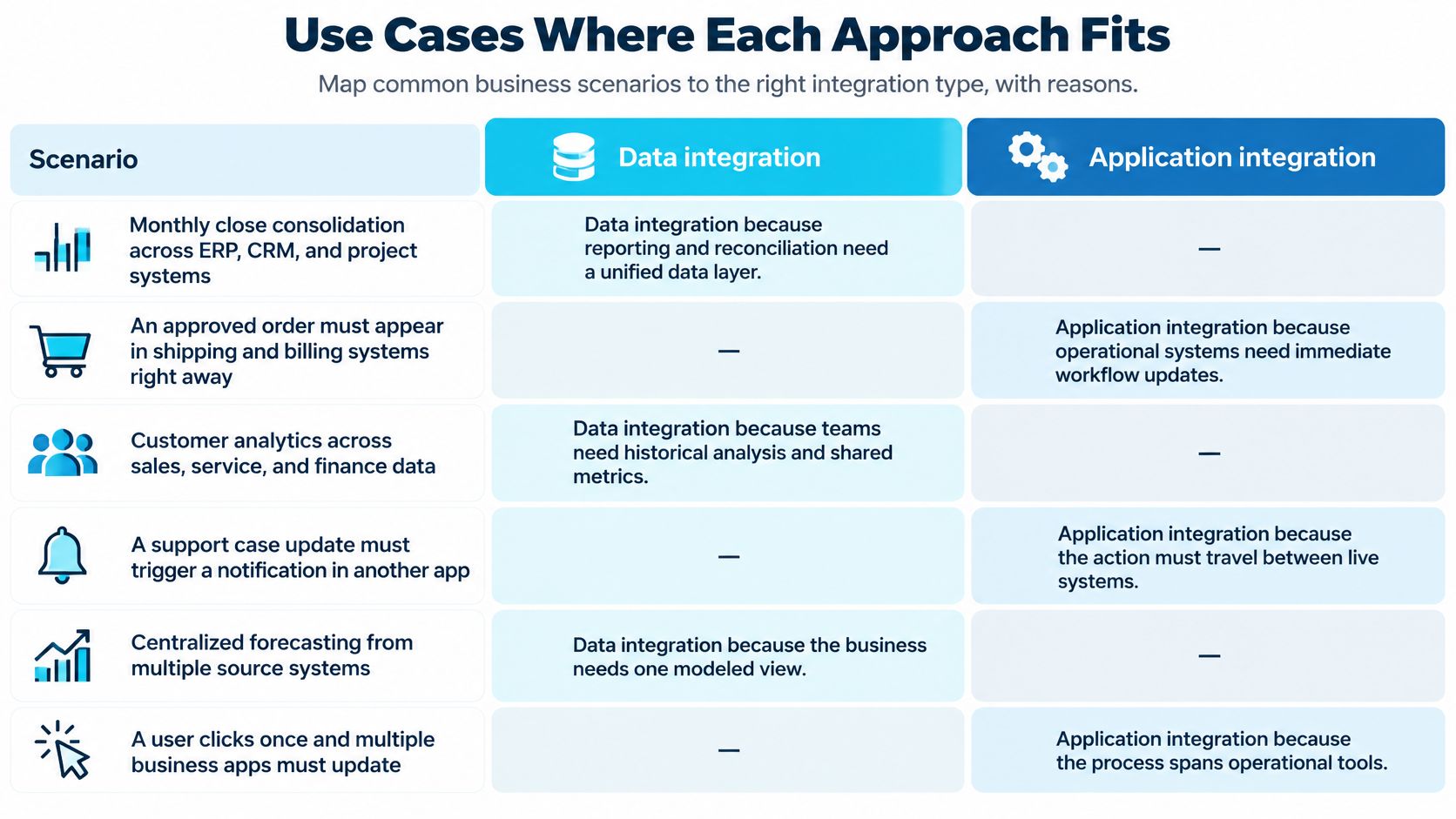
Business scenarios and the integration type that fits
| Scenario | Primary need | Better fit |
|---|---|---|
| Monthly close consolidation across ERP, CRM and project systems | Consistent, governed history | Data integration |
| Approved purchase order sent to a supplier with inventory update | Transaction completed across systems | Application integration |
| Quality escape analysis across inspection, production and supplier records | Reconciled cross-system dataset | Data integration |
| Document intake routed into ERP or project workflow | Extraction plus workflow completion | Both, with a defined hand-off |
| Customer order triggering a production schedule change | Immediate system action | Application integration |
| Training data assembly for a predictive quality model | Historical, well-defined records | Data integration |
Match the integration to the decision
For monthly close, finance needs consistent reporting boundaries across systems. Copying current balances without retaining the relevant reporting context won't produce a dependable consolidated view.
Quality escape analysis requires engineers to join inspection findings to production batches and supplier records. The difficult work is resolving identifiers and meaning, not issuing commands to operational applications.
Predictive-quality training adds another requirement: records must represent what was knowable at the relevant decision point. Including information recorded after an outcome can make a model evaluation misleading.
Operational scenarios have different acceptance tests. A purchase-order workflow needs confirmation of the supplier-facing action and a defined inventory transition. A customer-order change needs scheduling rules that prevent an unapproved request from becoming a released production instruction.
Define the mixed-case handoff
In our AEC document-intelligence work, we integrated Procore and Outlook so the system fits existing workflows. For a firm using those documents in a portfolio dashboard, the analytical feed needs its own publication rules; successful routing alone doesn't establish a reliable portfolio measure.
We've also built connectors to a client's existing ERP, including an SAP connector, so purchase orders populate without manual re-entry. An analytical pipeline can consume cleaned order history separately, without becoming responsible for submitting orders.
For either scenario, assign an owner at the boundary between validated extraction and operational submission. Specify the acceptance condition, retained document reference, rejection path and acknowledgment that proves the receiving application accepted the work. That handoff is where a mixed architecture becomes an operable service rather than a chain of connectors.
Implementation Tradeoffs and Failure Patterns
Real-time processing can make an integration worse when consumers act on unapproved or incomplete changes. A faster inventory update is harmful if it represents a purchase-order draft rather than an authorized commitment.
Batch processing offers a deliberate reconciliation boundary, but consumers receive no newer published state between loads. It can avoid unnecessary continuous processing, although cost still depends on workload, platform pricing and recovery requirements. Neither mode compensates for an undefined business rule.
Evaluate maintenance and portability
Point-to-point API connections spread authentication, mappings and retry logic across individual implementations. Reusable APIs and integration flows can reduce that duplication, but shared components need versioning and named maintainers. Otherwise, a change intended for one consumer can disrupt others.
Platform dependence also extends beyond connector availability. Hidden mappings, undocumented orchestration and vendor-specific runtime behavior make migration difficult. Keep transformation logic version-controlled and documented, and use portable code where practical without pretending that every managed service is interchangeable.
We don't introduce proprietary platforms that create new vendor dependencies. That design choice still requires explicit documentation of the external systems, identities and operational contracts the implementation depends on.
Integration failure symptoms, causes and fixes
| Symptom | Likely cause | Fix |
|---|---|---|
| Duplicate orders after retries | Consumer is not idempotent | Add idempotency keys and deduplicate on receipt |
| Dashboards disagree with the ERP | Conflicting business definitions across departments | Adopt a governed data dictionary with one owner per term |
| Nightly loads run for hours | Full reloads on every run | Switch to incremental change data capture |
| Orders stuck in a queue | Downstream rate limits or outages | Add backoff, retries and a dead-letter queue |
| Pipeline breaks after a source change | No schema-change detection | Add schema contract tests that fail before load |
Diagnose before applying the fix
These are diagnostic starting points, not proof of root cause. A long-running load might instead reflect an inefficient join, source contention or an undersized destination. Confirm where time is spent before introducing CDC and its additional state-management requirements.
Similarly, a dead-letter queue doesn't resolve an order. Operators need the rejection reason, authority to correct the problem and a controlled replay procedure. Preserve the original business identifier so replay doesn't become a new transaction.
Definitions deserve the same engineering attention as retries. Our aerospace data platform includes a 1,200-term data dictionary that resolved 47 conflicting definitions across departments. That is a semantic correction, not a transport optimization.
Choose a pattern by how it fails and how people recover it, not by the length of its feature list.
Measuring Integration Success After Go-Live
A successful transfer proves that something arrived. It doesn't prove the receiving team can trust it, act on it or explain where it came from.
In SAPinsider's integration and application-development report, 83% of respondents prioritize integrating SAP and non-SAP solutions, while 80% prioritize strong data-governance practices. Those priorities support treating governance as part of integration acceptance rather than a later cleanup task.
Use an operational scorecard
- Analytical health: Track freshness, completeness, duplicate rates and reconciliation differences. Separate missing source records from transformation failures.
- Workflow health: Track API and event latency, failed-message recovery time and unfinished business transactions. Transport acknowledgment shouldn't count as workflow completion.
- Change resilience: Measure schema-change detection time and identify workflows with traceable lineage. Record which mappings and versions produced each published result.
- Business outcomes: Track invoice-cycle time, procurement exceptions relative to order volume, rework hours and quality escapes. Agree on definitions before comparing results.
For AI workloads, add checks for document provenance, permission enforcement and consistent terminology. A connected dataset can remain unsuitable for an assistant or predictive model when users can't establish what a record means or whether they're allowed to access it.
Make measurement actionable
Each measure needs an owner, a threshold for intervention and an associated response. Observability should identify the affected records or transactions; validation should stop unsafe publication; rollback or compensating actions should have an authorized operator.
Our Enterprise AI Hub includes rate limiting and full audit trails through Application Insights. Audit trails help operators connect an action to its originating request, but teams still need a retention policy and a usable investigation process.
Record a baseline before go-live. Review reconciliation weekly during the first month, then review business outcomes monthly while continuing operational alerting. Treat that cadence as a starting operating practice, and tighten it where the consequences of undetected failure demand closer oversight.
Decide Which Layer to Fix First
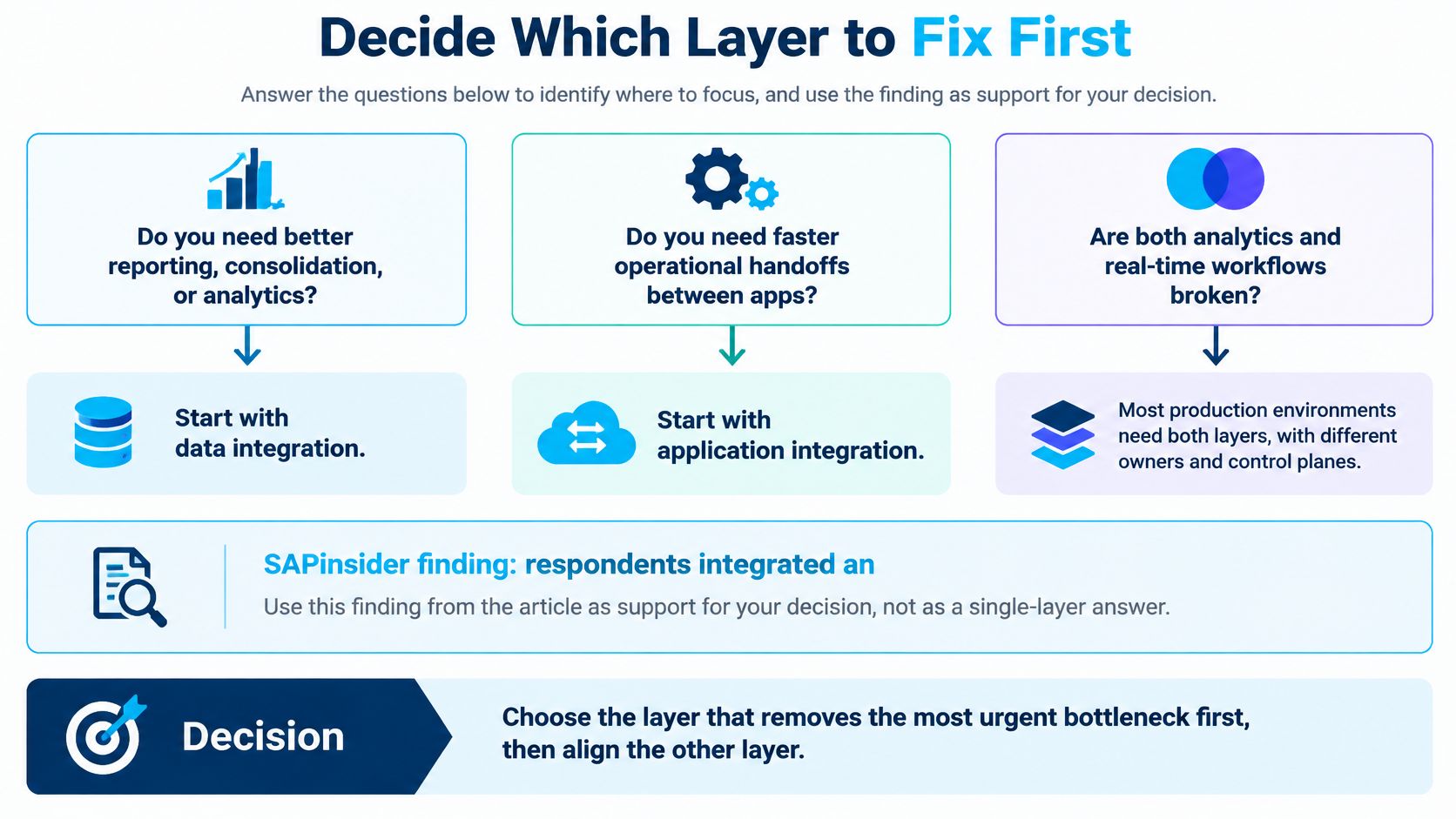
Which failure currently prevents the business from completing work or making a defensible decision? Fix that layer first, while defining the boundary it shares with the other.
SAPinsider's SAP BTP report found that respondents integrated an average of 37 applications with SAP in 2025, while the average number of integration tools fell from 20 to 11. Consolidating tools therefore doesn't remove integration design; it concentrates responsibilities in fewer platforms.
Establish the decision contract
- Which system is authoritative for each field? Resolve write authority before designing synchronization.
- Does the consumer need a committed transaction or an analytical view? Identify whether success means an accepted action or a trustworthy representation.
- What happens when delivery fails or records disagree? Define who can retry, reconcile, reject or compensate.
- Who owns the canonical model and reconciliation process? Name accountable people, not just participating departments.
Prioritize the blocking condition
If reports disagree, fix the data layer first. If orders or approvals stall, fix application integration first. If an AI pilot can't establish usable definitions, provenance or permissions, prioritize the data foundation rather than adding another model interface.
Most production environments need both layers, with different owners and control planes. Data teams control publication, lineage and reconciliation; application teams control authorization, transaction transitions and recovery. A shared platform doesn't erase those responsibilities.
This week, map each business invariant to an integration pattern and a named owner before the next sprint. Record the allowed delay and recovery action beside it so the team can choose an architecture on operational grounds.
Ryshe builds AI-ready data foundations with unified pipelines, governance frameworks, single-source-of-truth architecture and quality controls, alongside ERP, CRM and Microsoft 365 integrations. Visit Ryshe to discuss which data or workflow bottleneck to address first and how to define acceptance criteria for both layers.