Data Strategy Consulting: What It Covers and Delivers
Data Strategy Consulting explained: what it covers, which deliverables matter, when organizations need it, and how to prove its value to the business.

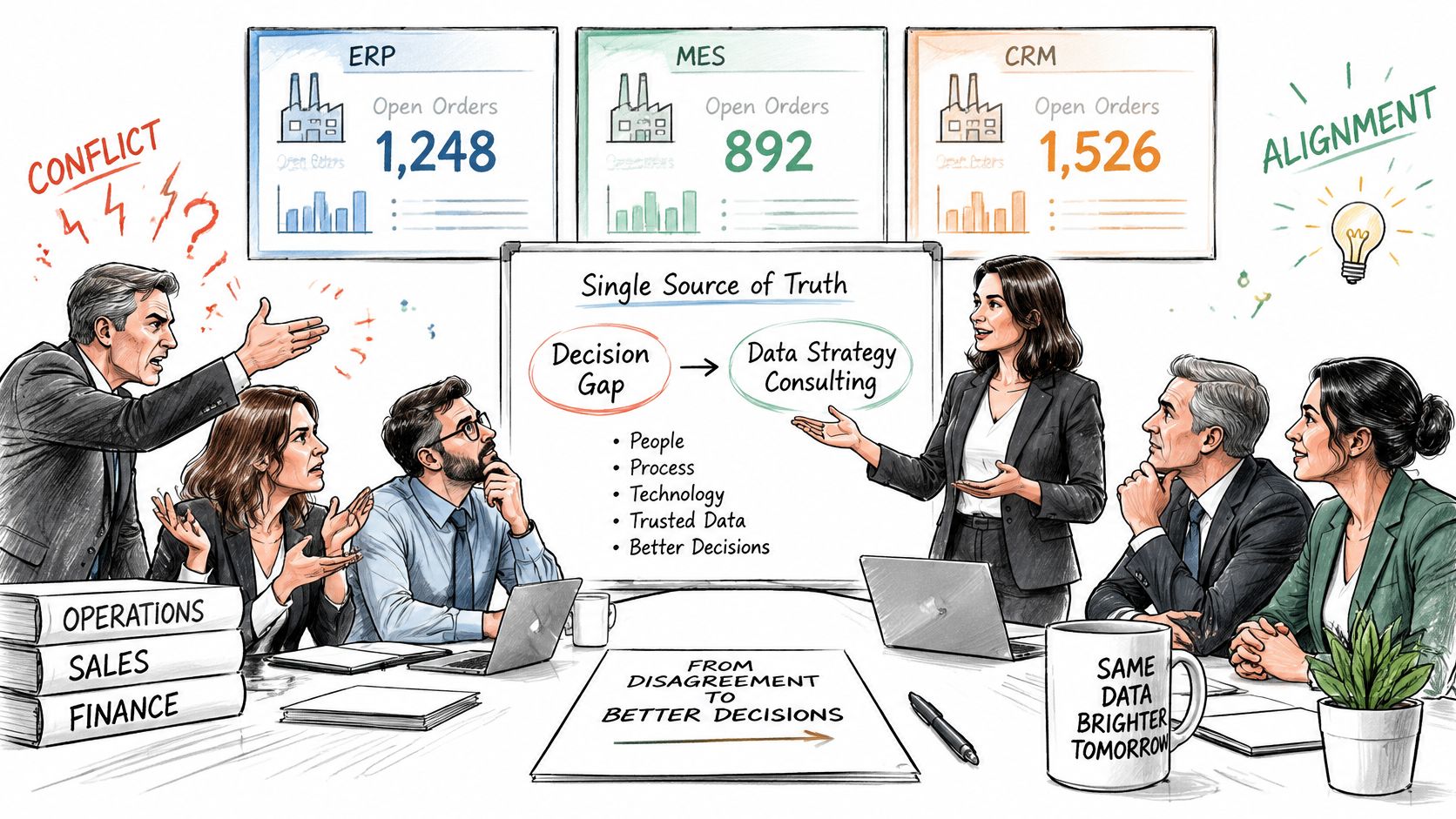
Your manufacturer's leadership meeting starts with three dashboards showing three different order counts. Finance counts invoiced orders, operations counts released work orders, and sales includes bookings that haven't reached production. Instead of deciding whether to add capacity, everyone debates whose number is right.
That's a useful starting point for data strategy consulting. The immediate problem looks technical, but the unresolved questions are managerial: which decision are you making, which definition supports it, and who has authority to settle disagreements?
What Data Strategy Consulting Covers
A data platform is like a city's road network and utilities. Data strategy is the master plan that determines where roads go, who maintains them, and which districts get built first. Buying infrastructure before agreeing on those choices can leave you with expensive connections that don't serve the work people need to do.
In the order-count scenario, a consultant shouldn't begin by recommending another dashboard. They should ask whether leadership needs to understand demand, production workload, or recognized revenue. Those are different decisions, and each can legitimately require a different measure.
The questions behind the work
A useful engagement connects these questions:
- Business decisions: What action should someone take with better information?
- Data requirements: Which records, definitions, and quality levels support that action?
- Ownership: Who maintains the information and resolves exceptions?
- Delivery: What should the team build first, and what must happen before it can operate?
The resulting scope usually includes business use cases, source-system assessment, architecture and integration, governance, and a delivery roadmap with value targets. For work approaching implementation, Vision's production deployment planning template is a practical companion for organizing the transition from design to operational release.
Platform selection, dashboard development, and AI use-case discovery can all belong within the work. None substitutes for strategy. A platform recommendation doesn't settle who approves access. A dashboard doesn't establish which definition is authoritative. An AI opportunity list doesn't identify who will change the underlying workflow.
Practical test: If the work doesn't identify owners, decisions, and measurable outcomes, it isn't yet a usable strategy.
When Organizations Need Data Strategy Consulting
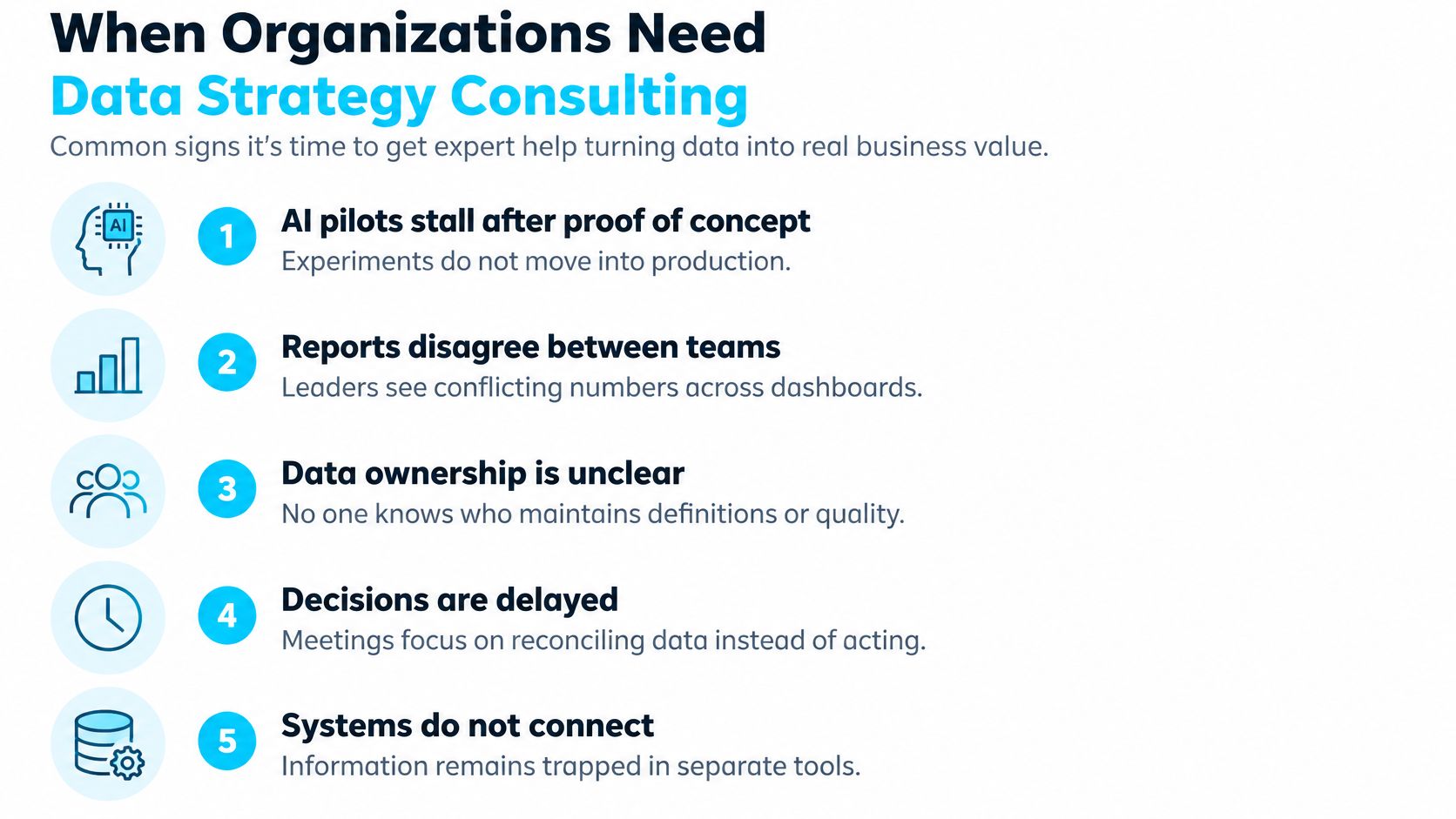
Look for recurring symptoms rather than a particular company size or job title. An isolated reporting defect may need a repair; problems that cross departmental boundaries usually require decisions about how people share responsibility.
| Symptom | Likely Cause | Consulting Focus |
|---|---|---|
| AI pilots stall after proof of concept | Unclear ownership and readiness gaps | Readiness assessment and governance |
| Same customer or part has different IDs across systems | Master data gaps | Master data model and identifiers |
| Plants or project sites use different standards | Operating-model conflict | Federated ownership with shared enterprise controls |
| Manual document reconciliation consumes staff hours | Weak data flows between systems | Pipelines and document intelligence scope |
| Finance and operations report different numbers | Conflicting definitions | Business glossary and data dictionary |
| Compliance evidence takes weeks to assemble | Missing lineage and audit trails | Lineage, catalog and audit logging |
These symptoms become more consequential when teams compensate with spreadsheets, private lookup tables, or undocumented corrections. Before commissioning a broad transformation, establish whether the same underlying issue affects several workflows.
Why industrial environments need different choices
Verdantix's industrial AI and data-management analysis reports that only 6% of surveyed organizations had full integration across operational, information, and engineering technology systems, while 75% identified data quality as a significant or very significant barrier to industrial AI analytics.
For independently developed plants and project sites, connecting systems is only part of the task. Someone must decide which standards apply everywhere and who owns engineering context when ERP, manufacturing execution, and product lifecycle systems disagree.
Consider a part revision. Engineering may own the approved specification, while a plant owns the record of which revision was installed. Combining those records without preserving their meanings can undermine traceability.
A workable approach is federated implementation with shared enterprise controls. Central teams establish identity, security, metadata, quality rules, and portability requirements. Plant or project teams retain responsibility for implementing those controls within their operating context.
If the symptoms are confined to a workflow, start with a focused assessment. If they recur across functions and sites, scope operating-model decisions alongside the technical strategy. Don't require every location to adopt an identical model before a useful local improvement can begin.
Deliverables a Useful Strategy Should Include
Judge a strategy by whether the receiving team can act on its artifacts the following week. Each deliverable needs an explicit quality test, not just a place in the final presentation.
| Deliverable | What It Contains | Quality Test |
|---|---|---|
| Current-state data audit | Source systems, owners, quality scores and integration points | Every critical source has a named owner and a quality score |
| Business use-case map | Decisions and workflows that need data, scored by effort versus impact | Each use case links to a measurable business outcome |
| Target data architecture | Pipelines, storage layers, master data model and access controls | Teams reuse core datasets without copying them |
| Governance and ownership model | Stewards, decision rights, access policies and quality thresholds | A named person can approve a change to a critical field |
| Data contracts for critical sources | Schema, update frequency, completeness and validity thresholds, exception handling | Breaches trigger alerts instead of silent failures |
| Prioritized roadmap | Phased work, dependencies, sizing and acceptance criteria | Each phase ends with a verifiable result |
Make the artifacts executable
Start with evidence in the audit. A quality score should come from documented checks, such as missing supplier identifiers or invalid inspection dates. Record the rule, the records tested, and the person responsible for resolving failures.
The use-case map should describe a decision or workflow, not a technology category. Improving purchase-order exception handling is actionable; implementing AI is not. Assign a business owner who can confirm whether the proposed improvement matters.
For the target architecture, trace a critical record from its source through transformations to the consuming application. Identify which dataset others should reuse and how they obtain authorized access, rather than creating another uncontrolled export.
The governance model must distinguish accountability from maintenance. A business owner approves meaning and acceptable risk; a steward maintains definitions and investigates defects. A practical data governance framework makes those responsibilities visible at the point where someone requests a change.
Treat reliability as an operating requirement
A data contract is a written agreement between the team supplying data and the team consuming it. Specify field names and types, update frequency, completeness and validity thresholds, steward ownership, exception handling, and audit logs. Then test the agreement continuously, including what happens when a source stops updating or changes its schema.
The AI risk-management submission hosted by NIST emphasizes repeatable data delivery, lineage collection, and evaluation across architecture, governance, quality, adoption, and security. Apply that principle by testing controls under conditions resembling deployment, rather than accepting a clean assessment sample as proof of ongoing reliability.
Finally, the roadmap should specify dependencies and acceptance criteria that a named reviewer can verify. For example, procurement can accept an exception-handling release only after representative documents pass agreed checks and unresolved items reach the correct queue. A deliverable that cannot pass its quality test is a document, not an operating strategy.
Why Alignment Matters More Than Platforms
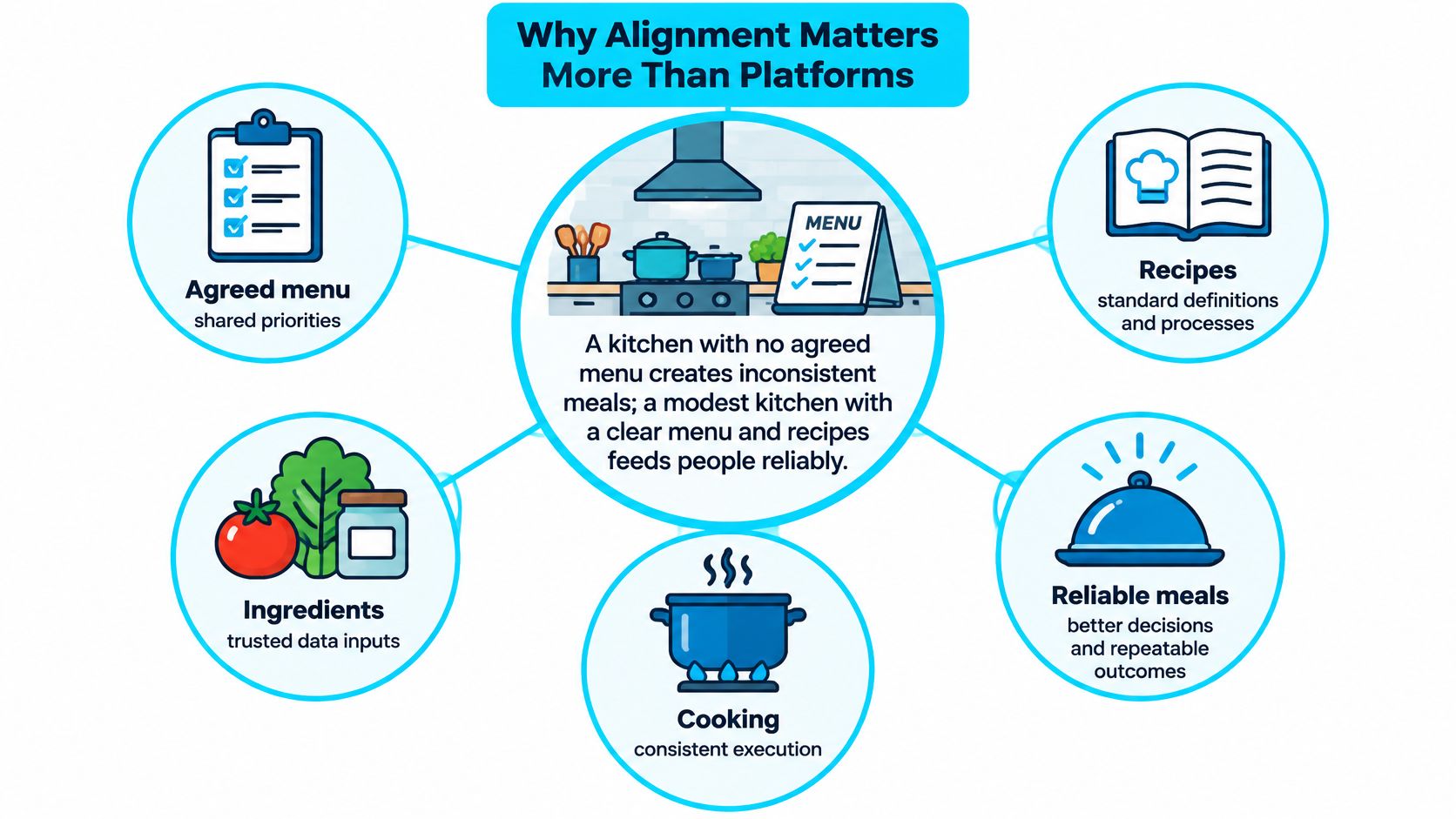
A well-equipped kitchen with no agreed menu produces inconsistent meals. A modest kitchen with a clear menu and recipes can feed people reliably. Technology matters, but people first need agreement about what they're producing and how they'll judge it.
In McKinsey's global survey of 1,000 companies with more than $1 billion in annual revenue, organizations identified as leaders in scaling analytics were 2.5 times more likely than peers to report a clear data strategy and twice as likely to report strong data-governance practices for identifying and prioritizing data.
Check the foundations of shared meaning
The findings describe connected elements that executives can examine without becoming data architects:
- Business-oriented data ontology: A shared description of business concepts and their relationships. For example, distinguish a customer organization from its billing accounts and delivery locations.
- Cross-domain master-data model: A consistent way to identify customers, products, locations, and employees across systems.
- Explicit accountability: Clear responsibility for data quality and maintenance, including authority to resolve disputed definitions.
Say sales defines an active customer as an account with an open opportunity. Finance uses recent invoices, while support uses an active service agreement. A new platform can faithfully collect all those records and still leave leadership with an ambiguous customer count.
The solution isn't necessarily to abolish the departmental definitions. Preserve valid operational distinctions, label them clearly, and agree which definition supports each enterprise decision. Someone with business authority must approve that choice.
Separate organizational authority from technical capability
A developer can implement a filter, but shouldn't have to decide which customers leadership considers active. Similarly, an integration engineer can map identifiers, but needs an accountable owner to approve uncertain matches. A sound data integration strategy connects systems without concealing those unresolved business judgments.
Agreement doesn't mean every team uses the same metric. It means people understand the differences and know who can authorize a change.
The survey shows association, not proof that strategy alone causes stronger performance. It doesn't establish that governance can compensate for unsuitable infrastructure or weak execution.
The practical implication is narrower and more useful: reserve meaningful consulting effort for definitions, decision rights, and ownership. If every meeting concerns storage engines and cloud services, ask where the business decisions will be made, recorded, and approved.
How a Strategy Engagement Runs Step by Step
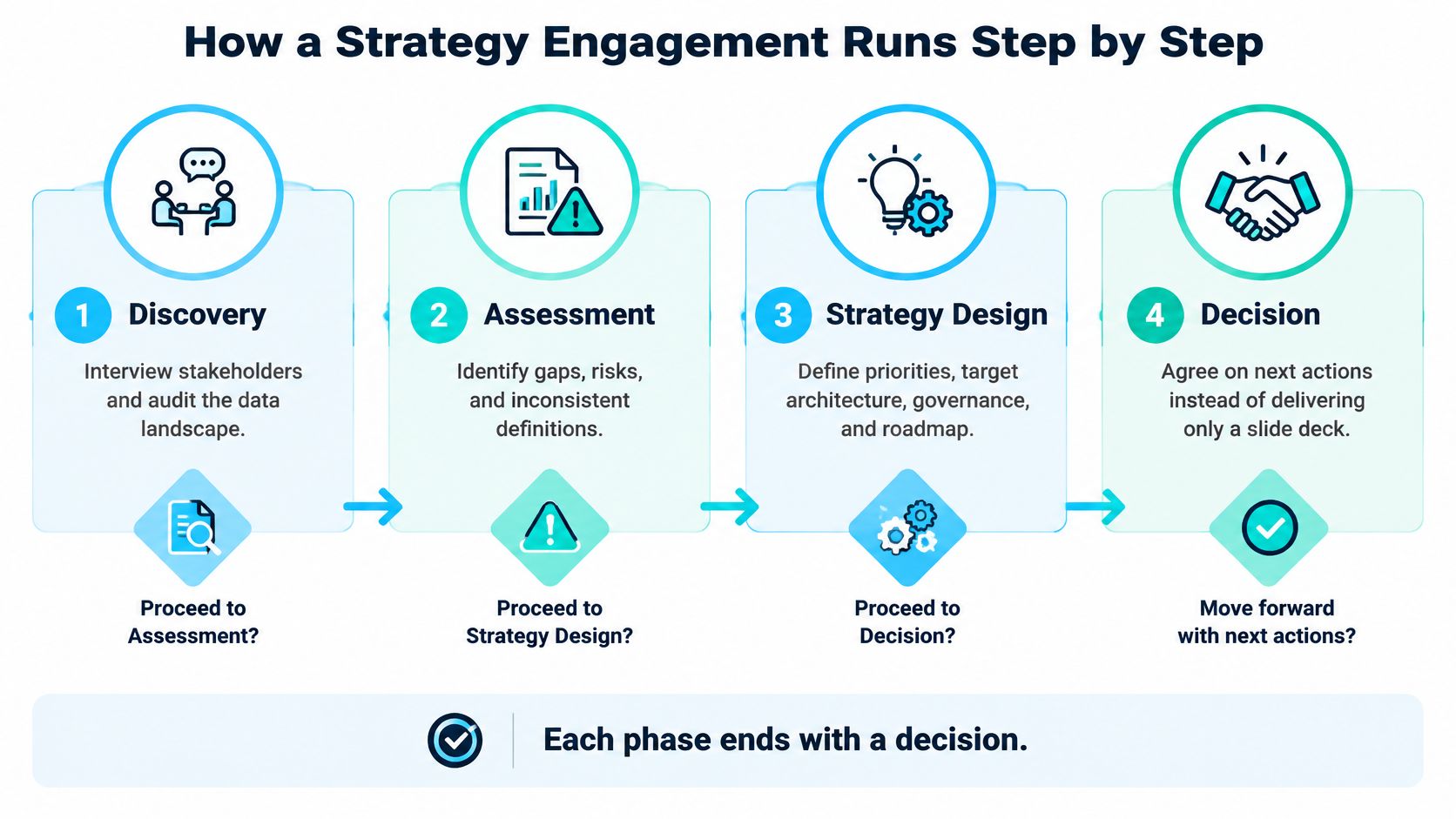
A strategy engagement should move through explicit decision gates. The sequence below is a useful working model, not a promise that every organization needs an identical project.
Discovery. Interview stakeholders, map current processes, and identify the information behind important decisions. Skipping this work invites architecture designed for imagined use cases; the exit decision is which business problem deserves investigation.
Data health check. Inspect source systems, quality, integration points, and existing tooling, then record blockers and unresolved definitions. Treating this as a formality pushes defects into implementation; the exit decision is whether the proposed use case is feasible with identified remediation.
Analysis. Match candidate opportunities to organizational capabilities and compare effort with business impact. Don't rank attractive demonstrations above workable improvements; the exit decision is which opportunity receives investment and which alternatives wait.
Design and roadmap. Define architecture, governance, ownership, dependencies, and phased acceptance criteria. Avoid a future-state diagram without an executable starting point; the exit decision is what the delivery team is authorized to build.
Match the sequence to the scope
At Ryshe, our data foundation process begins with a Data Health Check covering sources, quality, integration points, and current tooling. Our AI readiness process includes a broader discovery stage: its first week involves stakeholder interviews, a data audit, process mapping, and competitive environment analysis.
Those are different entry points, not interchangeable labels. Choose the scope according to whether you need to repair the information foundation or evaluate organizational readiness for an AI initiative.
For materials teams, Polymerize's roadmap for R&D transformation offers a domain-specific reference for considering a transformation sequence. Keep the local decision gate explicit, such as whether experiment records are sufficiently consistent to support the intended comparison.
Include handoff in the plan
A well-run engagement leaves the client able to operate what was built. Our final data foundation step includes production validation, team training, and documentation handoff, after which the platform runs independently without ongoing dependency on Ryshe.
Cost and duration follow scope. Relevant factors include business units, source systems, separate plant or project-site assessments, and whether the work covers focused readiness or full operating-model design. Treat a fixed quote offered before those boundaries are understood with caution.
The first authorization should be concrete: a priority use case, an accountable owner, and a measurable target.
Proving the Value of a Data Strategy
Cisco's 2025 AI Readiness Index found that eight in ten organizations experienced sharply increased pressure to demonstrate tangible AI ROI during the preceding six months, while only 58% reported a well-defined AI strategy. Pressure to demonstrate value isn't the same as having a measurement method.
A target architecture is not a business result. Before implementation, connect each proposed benefit to a metric that the relevant business leader recognizes.
| Metric | What It Shows | Example Baseline |
|---|---|---|
| Duplicate records and databases | Architecture waste | Count across ERP, CRM and project tools |
| Manual reconciliation hours per month | Cost of poor data flow | Hours logged by finance and project teams |
| Pipeline failure rate | Reliability of data delivery | Failed runs divided by total runs |
| Time to produce compliance evidence | Lineage and governance effectiveness | Days from request to packaged evidence |
| Model rework cycles | Data readiness for AI | Retraining or rebuild cycles per use case |
| Projects delivered on time and budget | Delivery discipline | Share across an agreed historical reporting window |
| Cycle time or rework on the target workflow | Operational outcome | Measure before go-live and again after adoption |
Establish a defensible comparison
Define each metric before collecting it. For duplicates, specify what constitutes the same business entity; for reconciliation hours, separate routine review from correcting missing or inconsistent records. Otherwise, teams can report an apparent improvement just by changing how they count.
Record workload and operating conditions alongside the baseline. A quieter procurement period can reduce processing time without any technical improvement, while more complex documents can obscure a genuine gain. Compare similar work where possible and document other process or staffing changes.
Name the acceptance authority in advance. Operations should confirm that the workflow improved, IT should validate reliability, and finance should approve how time savings or avoided costs translate into the benefits case.
Count the work required to make data usable
Include source cleanup, mapping, validation, security, training, monitoring, and ongoing stewardship in the cost estimate. Examining the cost of bad data helps distinguish visible software expenditure from staff effort already absorbed by operational teams.
Don't equate released staff capacity with cash savings unless someone can explain how that capacity will be used. Likewise, a technically successful pilot has no realized operational benefit if users bypass it.
Measurement rule: Agree on the baseline, comparison method, and acceptance owner before approving implementation.
Start with a narrowly defined workflow whose inputs and outcomes you can observe. Instrument its use, measure adoption, and verify the operational result before expanding the investment.
Choosing a Partner and Confirming Your Next Step
Evaluate a consulting partner by what your team will be able to decide and operate after the engagement. Sector familiarity matters, but recognizable terminology isn't enough. The provider must translate that familiarity into clear boundaries, usable artifacts, and accountable delivery.
Use this checklist during selection:
- Business-first framing: Can the team describe the decision to improve before discussing preferred tools? Ask, “What would you need to learn before recommending a platform?”
- Named senior responsibility: Who handles implementation quality, coordination, acceptance, and risk escalation? Our engagements assign a senior Solution Architect / Delivery Engineer and Program Manager to those responsibilities.
- Written acceptance criteria: What evidence closes a delivery phase? We establish scope, dependencies, sizing, and acceptance criteria before implementation.
- Client ownership: What can your team retain and operate? Our clients own their data, code, configurations, documentation, and client-specific work product; we retain our pre-existing frameworks and accelerators.
- Comparable operational context: Can the provider explain how it handles engineering revisions, document exceptions, or regulated records? Ask for an example that matches your workflow, not merely your industry label.
Choose for the job you actually have
Ryshe is an engineering-led provider serving architecture, engineering, construction, manufacturing, and aerospace organizations. We can deliver a structured AI readiness assessment with a readiness scorecard, a prioritized roadmap with ROI projections, production-ready AI solutions, and client-owned deliverables supported by documentation and team training.
Other firms may better fit a different technology environment, specialist requirement, or advisory-only scope. ROI projections remain assumptions to test, not guaranteed results, and a proposal should distinguish assessment outputs from implementation commitments.
Before the first scoping conversation, list the decisions most affected by unreliable information and name the business owner for each. Bring a conflicting report, a representative document, or an example of a failed handoff. Those artifacts give the consultant something concrete to investigate and help you judge whether the proposed work addresses the actual problem.
Ryshe offers data foundation work and AI readiness assessments that connect data quality, governance, and technology decisions to an actionable implementation roadmap. Visit Ryshe to discuss a data health check or readiness discovery scoped around the three business decisions most affected by unreliable data, with an owner and intended outcome for each.