10 Best Digital Transformation Consulting Firms for 2026
Compare 10 digital transformation consulting firms for 2026, with practical criteria for assessing expertise, delivery models, and fit.
You built the shortlist the way most buyers do. A recognizable brand, a peer referral, whoever answered the RFP fastest. Then the proposal lands, the team you met at the pitch is replaced by people you've never spoken to, pricing is buried in a blended rate, and deliverable one is a maturity assessment you could have written yourself.
The problem isn't that you picked a bad firm. It's that you compared brands when you were really choosing a delivery model. There are four worth separating: continuous senior capacity you schedule month to month, enterprise program scale for multi-year multi-platform work, industrial and IT/OT engineering for plants and asset-heavy operations, and Microsoft-platform specialization for teams already standardized on Azure, Fabric, Dynamics 365, or Power Platform. Market Research Future sized the global digital transformation consulting market at $249.96 billion in 2024 and forecast $268.46 billion for 2025, per its market report, so every model has firms that do it well and several that do it badly.
Four criteria decide which is which, and the same four apply to all ten entries: whether the named people stay on the work, who owns deliverables and written acceptance criteria, whether platform advice is pragmatic or an upsell, and how pricing is structured. Each entry closes with the honest limitation and the case for dropping that firm from your shortlist.
One boundary worth setting before you read further. If the work is running infrastructure rather than changing how a business operates, it isn't a consulting purchase at all. Compare top managed IT providers on that side of the line, because the buying criteria are different.
1. Ryshe
Delivery model: continuous senior capacity, engineering-led. Ryshe suits AEC, manufacturing, and aerospace teams with a roadmap and no delivery bench: organizations that need AI, data integration, and automation work to keep moving across quarters without a new statement of work every time.
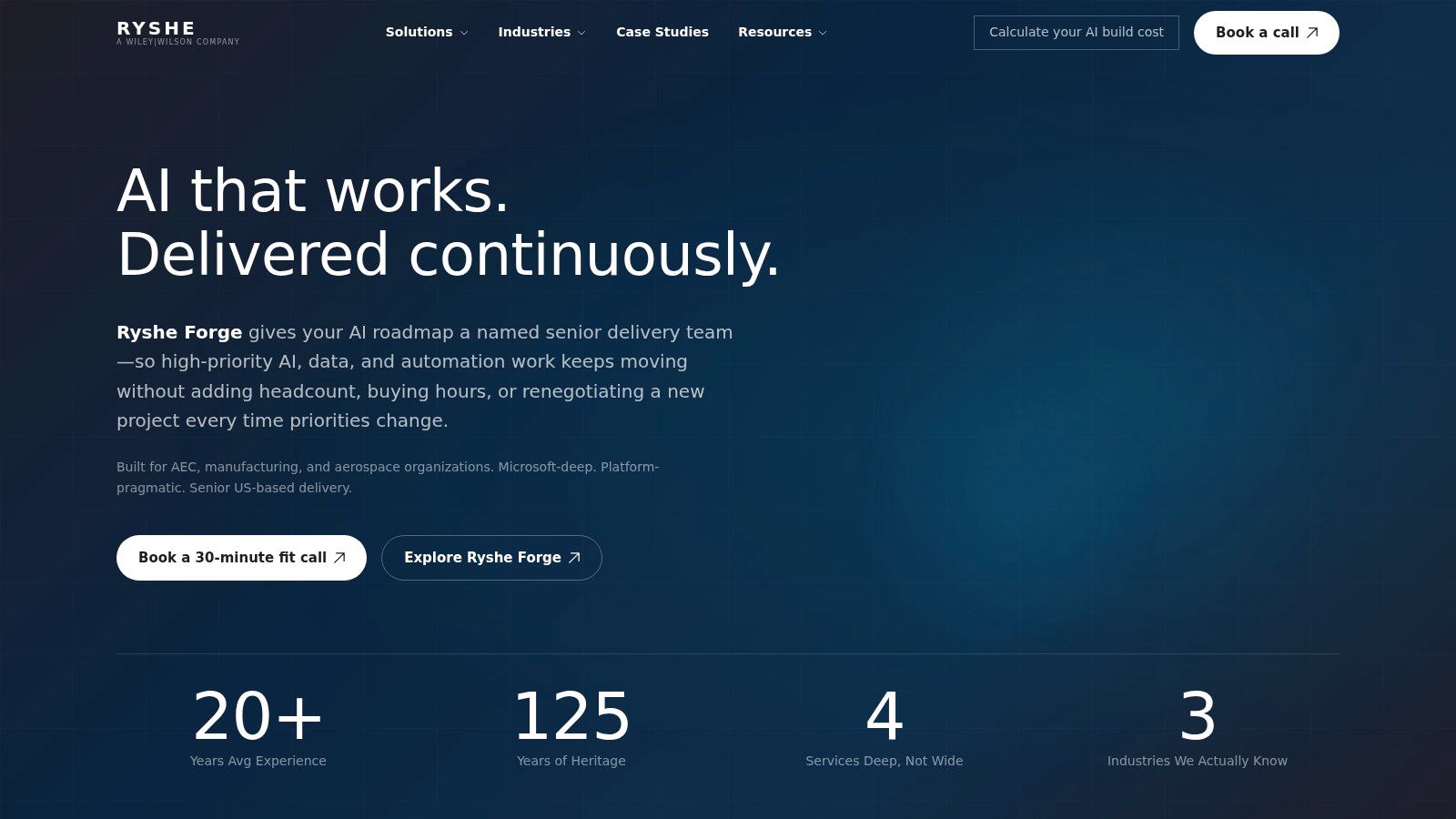
Ryshe Forge is the continuous model. You get reserved monthly capacity from a named, senior, U.S.-based pair, a Solution Architect/Delivery Engineer and a Program Manager, and work is prioritized and sized in advance with written scope, dependencies, and acceptance criteria. Pricing is a predictable monthly fee tied to that reserved capacity, scoped in a discovery call where a senior engineer rather than a sales rep walks through your situation.
What the work actually covers
Scope runs from AI readiness assessments and document intelligence through workflow automation, internal knowledge agents, data pipelines, ERP/CRM and Microsoft 365 integration, and the production layer most consultants skip: security, monitoring, deployment, documentation, and handoff. Clients retain ownership of data, code, configurations, and documentation, and the architecture is built to be portable rather than tied to one vendor.
The evidence is industry-specific. In a document intelligence engagement for a 200-employee architecture and engineering firm running 30 or more concurrent projects, project managers saved 15 hours per week each, retrieval ran 74% faster, and annual time savings reached $480,000 over four months. An Enterprise AI Hub reached production in six weeks in 2025.
Where it breaks down: monthly capacity suits organizations with steady demand. If you have one time-boxed build a year and nothing after it, Ryshe Labs is the right entry point, since it handles discrete projects, product development, platform replatforming, and applied research.
Score it against the four criteria and the model holds: the named pair stays on the work, deliverables ship against written acceptance criteria, the architecture stays portable, and the monthly fee keeps pricing out of hourly-meter territory. Ask for references in your sector during the discovery call, and use the Ryshe website to test fit first.
2. Accenture
Delivery model: enterprise program scale. Accenture fits organizations that need hundreds of people across several platforms, regions, and workstreams, and that can absorb a multi-year governance structure. It's the short answer when the program has a board-level deadline and no internal capacity to staff it.
Boards keep ranking digital technology among their top strategic priorities, and transformation budgets have grown with that demand. Programs of that size are Accenture's home turf. What buyers underestimate is that scale cuts both ways: the same governance machinery that keeps a forty-country rollout on track will bury a single-country pilot in status calls and steering decks.
It fits when the work is multi-platform: ERP, cloud migration, data platform, and organizational change running at once, with Industry X capabilities for industrial operations and asset lifecycles. It breaks down on contained initiatives. If you need one document workflow automated in eight weeks, you'll pay for coordination overhead you don't need: program management layers, staffing pyramids, and account structures built for engagements ten times your size. Pricing stays proposal-based, so budget clarity arrives inside the sales process rather than on a rate card.
Scorecard note: ask for the named engagement lead and the senior-to-junior staffing ratio in writing before you sign, because the pitch team and the delivery team aren't always the same people.
For teams whose real constraint is cloud migration rather than a full program, cloud services consulting covers the narrower route. Accenture's technology transformation practice lists the full scope.
3. Capgemini
Delivery model: industrial and IT/OT engineering. Capgemini suits manufacturers, aerospace and defense primes, and process operators whose transformation has to reach the plant floor: MES/MOM, manufacturing data platforms, IT/OT convergence, quality, and supply chain operations.
The number that matters
Industrial work is where transformation most often fails. McKinsey's survey of 1,793 executives found more than 80% of organizations had undertaken a digital transformation in the previous five years, yet only 16% reported the effort both improved performance and sustained those gains over time, and success rates in traditional, asset-intensive sectors ranged from 4% to 11%, per McKinsey's transformation research. That's the bar, and it explains why the assigned team matters more than the methodology.
It fits when engineering expertise and operating-model change belong in the same scope, especially in regulated environments where production continuity can't be gambled. It breaks down on portfolio breadth: management consulting, IT services, and engineering all sit under one brand, so a detailed proposal can still route your plant-floor work to a different practice or a subcontractor. Small discrete builds rarely justify the structure.
If you're weighing bought capacity against an internal hire, AI consultant vs building in-house sets out the trade-offs. Capgemini's services overview shows the practice split.
4. Deloitte
Delivery model: enterprise scale with business-process depth. Deloitte fits transformations where finance, supply chain, risk, and operating-model change move alongside the system. If the audit committee will ask who approved the control design, this is the room you want to be in.
Governance is the real test
Deployment is outrunning control almost everywhere. In Capgemini's 2025 global survey of 1,100 executives across 15 countries, 71% said they couldn't fully trust autonomous AI agents for enterprise use, and only 46% had established AI-governance policies, per Capgemini's generative AI research. A firm that treats governance as a launch checklist rather than an operating model will hand you a system nobody can defend.
It fits where organizational alignment, process redesign, and program management carry as much weight as the technology build. It breaks down when you need a fast, narrow technical delivery: procurement is heavier than a specialist engagement, the exact delivery team and work products should be specified before award, and public pricing doesn't exist.
Name the business owner, the technical owner, and the escalation path in the statement of work. Governance that lives only in a policy document dies the week your consultants leave.
For programs that hinge on data foundations rather than process design, data strategy consulting covers the sequencing. Deloitte's consulting services describe the practice areas.
5. IBM Consulting
Delivery model: enterprise scale with a modernization core. IBM Consulting suits organizations replacing core systems while standing up data, hybrid cloud, and AI capability, including estates where the work runs in Microsoft environments such as Azure and Fabric alongside existing IBM platforms.
The legacy squeeze
Execution is the weak point across the market. In a 2024 Gartner survey of 3,186 CIOs and technology executives across 88 countries, only 48% of enterprise-wide digital initiatives met or exceeded their business-outcome targets, per Business Wire's coverage of the Gartner findings. The same survey found 43% of CIOs planned to cut spending on legacy infrastructure and data-center technologies while 33% planned increases.
That split is where IBM earns its fee and where budgets get contentious. It fits when you are modernizing applications and running them afterward, since managed services can extend past implementation and keep the same system under one accountable owner. It breaks down on narrowly scoped engagements: the program scale is unnecessary, and platform, licensing, and implementation responsibilities need to be fixed in writing before work starts. Fees are not published, so pricing transparency scores low against the shortlist criteria and the commercial picture only clears up in negotiation.
One question decides most IBM shortlists. Which parts of the delivery will be done by people on the IBM payroll, and which by partners? Blended benches are where accountability blurs and timelines slip. IBM Consulting sets out its stated approach.
Score IBM high on platform pragmatism and delivery ownership for a modernization program. Score it low on team continuity until the contract names who actually shows up.
6. PwC
Delivery model: industrial program scale with an operations lens. PwC suits manufacturers connecting plant-level use cases to a business case a CFO will sign: predictive maintenance, digital twins, quality control, planning and scheduling, traceability, and connected IT/OT foundations.
Why the value question lands here
Measurement is not the gap. An SS&C Blue Prism survey of 1,650 executives across the Americas, Europe, and Asia-Pacific found 88% closely measure AI value, yet only 36% report consistent, recognizable value from their implementations, reported in Nasdaq's release on AI implementation governance. Capgemini's 2025 research found 93% of large organizations were exploring or enabling generative AI while only 30% were scaling it fully or partially.
It fits when the question is whether the investment pays back in the factory, not whether the model is accurate. It breaks down when advisory and implementation blur into one long workstream. Clarify which you're buying, and make sure the acceptance criteria measure cycle time, rework, defect escape, and auditability rather than hours saved.
A smaller, well-instrumented workflow proves more than a broad roadmap with no named owner after handoff.
PwC's consulting services describe its manufacturing and strategy work.
7. West Monroe
Delivery model: mid-market industrial and operations consulting. West Monroe suits manufacturers and private-equity-backed operators who want operations, data, and technology work under one engagement but can't justify a global integrator's coordination layer.
The outcome distribution problem
The economics of this work are uneven by nature. In a McKinsey survey of more than 1,700 C-suite executives, the average digital transformation had a 45% probability of delivering less profit than expected and only about a 10% probability of exceeding it, while the best-performing 10% of digitized incumbents captured as much as 80% of the digital revenue generated in their industries, per McKinsey's analysis of transformation odds. The lesson for a mid-market buyer is to demand a quantified business case before scaling, with sensitivity ranges and a stop/go threshold.
It fits industrial IoT and digital-factory work, ERP modernization, and analytics builds where the published examples show operational measures rather than adoption counts. It breaks down if you assume those results transfer. Case-study outcomes are client-specific, scope and pricing are custom, and you should verify the proposed team's experience inside a production environment like yours before signing.
West Monroe publishes its manufacturing case work openly, which makes the diligence easier.
8. Slalom
Delivery model: regional consulting with broad platform coverage. Slalom suits mid-market and regional enterprises that want senior people in the same time zone and a team assembled around a specific need rather than a packaged transformation program.
It fits when the work spans strategy, data, AI, cloud, implementation, and organizational change, and you need those pieces combined rather than sold separately. Slalom's Microsoft, AWS, and other partnerships mean you can keep an existing platform decision instead of re-litigating it. It breaks down on scope discipline: because services are assembled to order, the team composition and expertise can vary by location and practice, and nothing is priced publicly.
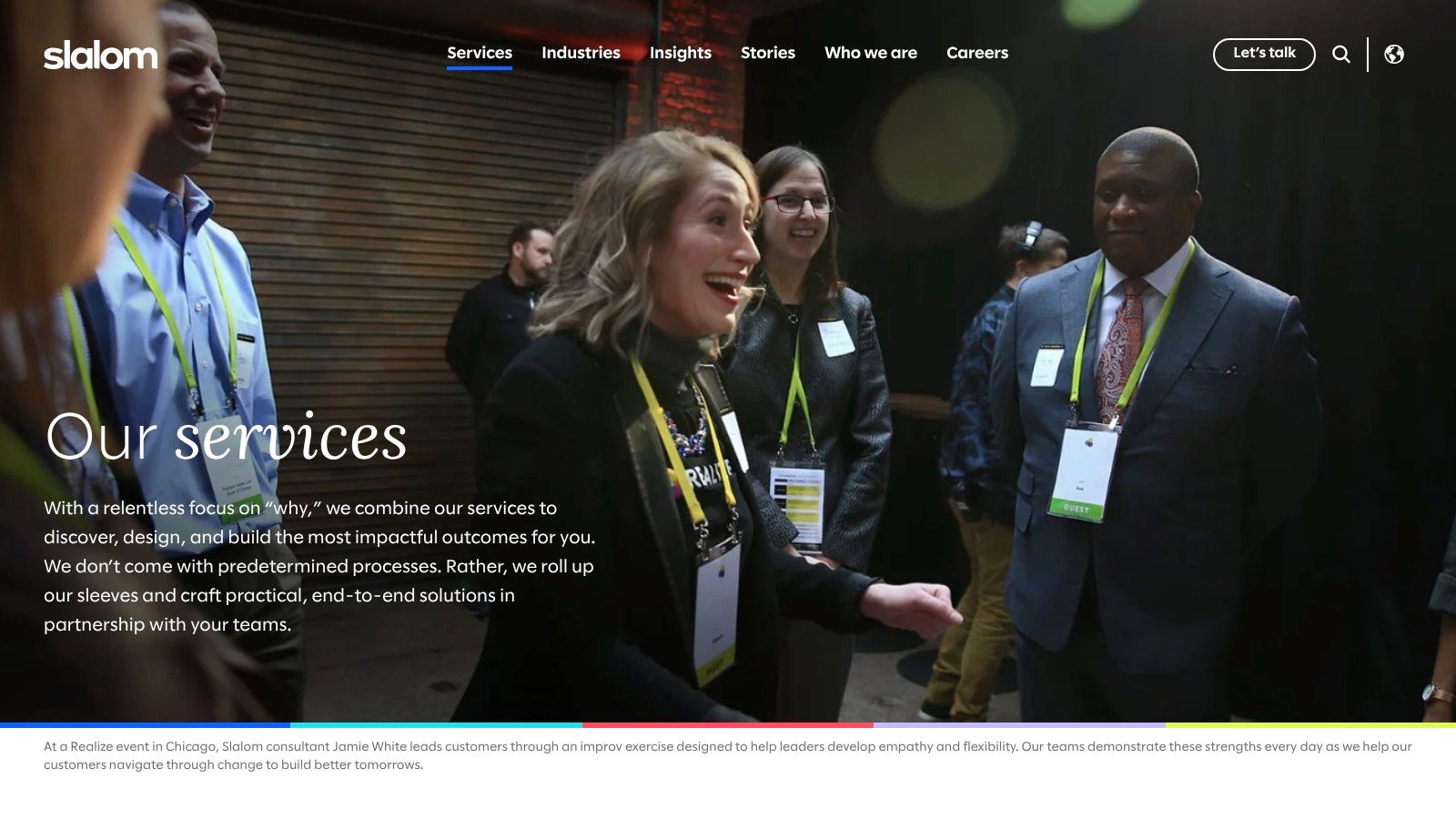
Treat it as a strong option when proximity and collaboration are the deciding factors, and as a weak one when you need one accountable firm to run a multi-country program. Ask which office owns delivery and who the named lead is, then confirm the answer appears in the contract.
What to verify before you shortlist it
- Named team in writing: roles, seniority, and the percentage of each person's time committed to your work.
- Platform neutrality: whether the recommendation holds if you keep your current stack.
- Handoff terms: what documentation and runbooks you receive at close.
Slalom's services lists the practices and platforms.
9. Crowe
Delivery model: Microsoft-platform specialization for manufacturers. Crowe suits manufacturers already running or deliberately choosing Microsoft: Dynamics 365, Azure, Power Platform, and Copilot, applied to operational improvement, workflow automation, analytics, and supply chain work.
It fits because the recommendations land in software you've bought or plan to buy, and the manufacturing context is genuine rather than retrofitted. Low-code Power Platform work can retire manual approval and reporting steps quickly. It breaks down for platform-neutral strategies: if your plant systems, integrations, or regulatory requirements point away from Microsoft, a Microsoft-first partner will still find a Microsoft answer.
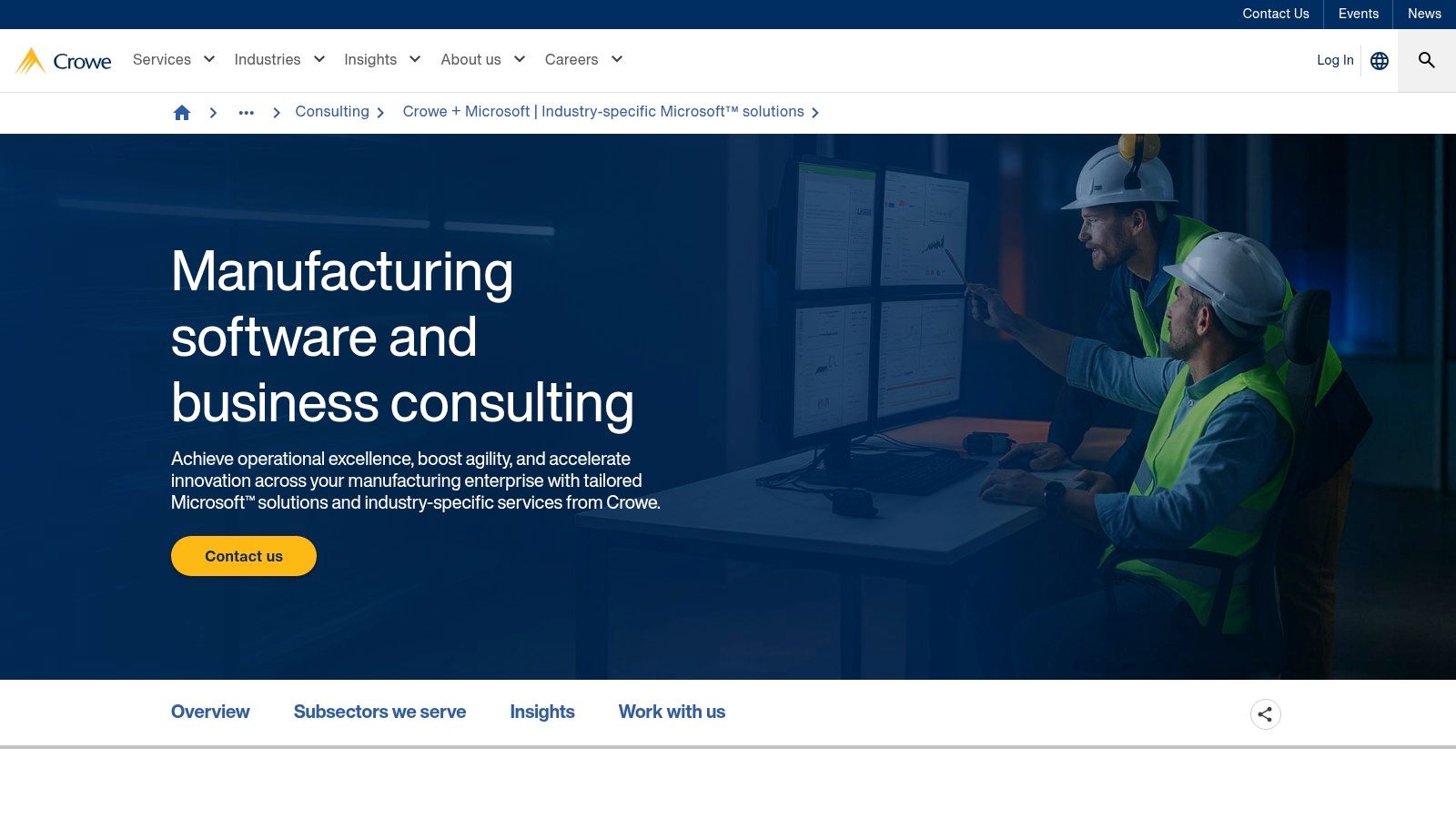
Before you commit, confirm fit for specialized plant systems, non-Microsoft ERP integrations, and any regulated validation requirements. Pricing isn't publicly available, so budget conversations start at the proposal stage.
The test is simple. Ask what the recommendation would look like if Microsoft weren't on the table, and listen for whether the answer changes.
Crowe's manufacturing and Microsoft consulting describes the offering.
10. MILL5
Delivery model: Microsoft-platform engineering with hands-on build capacity. MILL5 suits data and engineering teams that need implementation rather than advice: Azure and Microsoft Fabric platforms, custom AI, MLOps, IoT and real-time data, and modern application development.
It fits when your strategy is settled and the bottleneck is engineering throughput on a specific stack. Both project engagements and longer-term support are offered, which matters if you want the same team to stay through monitoring and retraining instead of handing back at go-live. It breaks down at scale: a smaller firm can't absorb several simultaneous enterprise programs, and industrial-process depth should be confirmed against your plant or production environment rather than assumed from a data-platform portfolio.
Ask for two references where the same engineers stayed past deployment, and for the monitoring and cost-ownership plan they handed over. Pricing isn't publicly posted.
MILL5 covers its cloud, data, and AI delivery work.
Delivery model, best fit, platform focus, and pricing transparency side by side
| Firm | Best Fit | Delivery Model | Platform Focus | Pricing Transparency | Main Limitation |
|---|---|---|---|---|---|
| Ryshe | AEC, manufacturing, and aerospace teams needing ongoing production AI and automation | Reserved monthly senior-team capacity; separately scoped projects for larger builds | Microsoft-focused but platform-pragmatic | Predictable monthly fee; exact rates not published | Monthly model may not suit occasional needs |
| Accenture | Complex, enterprise-wide transformation programs | Global strategy-to-execution teams | AI, data, cloud, integration, and industrial technology | Proposal-based; not public | Scale and coordination may exceed a contained project |
| Capgemini | Manufacturers and aerospace organizations connecting digital plans to production | Consulting, engineering, and operations programs | MES/MOM, manufacturing data, AI, and connected operations | Not publicly listed | Broad portfolio; small builds may be a poor fit |
| Deloitte | Transformations involving processes, governance, and technology | Cross-functional consulting and program teams | Enterprise systems, finance, supply chain, and IT | Not publicly available | Procurement and engagement may be heavy for small projects |
| IBM Consulting | Organizations modernizing core systems while building data, cloud, or AI capabilities | Strategy, implementation, and managed services | Hybrid cloud, AI, data, Microsoft, and IBM platforms | Fees not publicly listed | Scale may be unnecessary for narrowly scoped work |
| PwC | Manufacturers linking technology investment to operating performance | Strategy, consulting, and implementation planning | Digital manufacturing, IT/OT, analytics, and Microsoft | Not published | Multiple teams or workstreams may be involved |
| West Monroe | Industrial companies seeking business-focused technology transformation | Custom consulting and technology engagements | Industrial IoT, ERP, data, cloud, and AI | Custom scope and pricing | Case-study results may not generalize |
| Slalom | Organizations seeking tailored strategy and technology delivery | Flexible teams assembled around specific needs | Microsoft, AWS, cloud, data, and applications | Not posted publicly | Team expertise and availability can vary by location |
| Crowe | Manufacturers using or considering Microsoft platforms | Manufacturing-focused consulting and implementation | Dynamics 365, Azure, Power Platform, and Copilot | Not publicly available | Microsoft focus may not suit platform-neutral needs |
| MILL5 | Teams seeking hands-on cloud, data, AI, or IoT implementation | Project engagements and longer-term support | Azure, Microsoft Fabric, AI, MLOps, and IoT | Not publicly posted | Capacity may be limited for very large simultaneous programs |
How to Shortlist Three Firms and Run the First Conversation
Build the shortlist by model, not by logo. One continuous-capacity firm, one enterprise program firm, and one industrial or platform specialist gives you three different answers to the same brief, and it turns the comparison table into a working scorecard rather than decoration. If the engagement also hands a process to a third party afterward, this vendor selection framework for BPO applies the same discipline to the transition.
Score all three on continuity, ownership, platform pragmatism, and pricing structure before anyone writes a proposal. Then ask the four questions that separate capability from slideware.
- Who is the named delivery lead, and will that person still be on my account in month four? Get the answer in the statement of work, not the pitch.
- What written acceptance criteria govern the first milestone? If the criterion is a delivered document rather than a working workflow, you're buying activity.
- What happens to the code, configurations, and documentation at handoff? Client-owned, portable, and documented or it isn't finished.
- How does pricing adjust if scope moves by 20%? A firm that can't answer this prices by presence, not by outcome.
Run a 30-day test on one workflow
Pick a single document-heavy or integration-heavy workflow and instrument it for a month. Define cycle time, exception rate, rework, approval delay, and who monitors the system in week five. A firm that can't make a small workflow observable won't make a large program observable, and the pilot costs a fraction of a discovery phase.
Know the disqualifiers by type
A strategy firm that hands back at launch is wrong for a program that needs running systems. A global integrator that won't name its delivery lead is a coordination risk on a contained project. A Microsoft specialist that won't engage with your non-Microsoft estate will route every answer toward its own stack. A boutique without written scope and acceptance criteria is selling enthusiasm.
Continuous capacity is the fourth model, and it's the one most shortlists leave out. Ryshe Forge runs it as reserved monthly delivery from a named senior Solution Architect and Program Manager, with client ownership of data, code, and documentation, and Ryshe Labs picks up time-boxed builds when an initiative outgrows the monthly rhythm. That structure suits AEC, manufacturing, and aerospace teams whose AI roadmap spans quarters rather than a single fiscal year.
Run the first call with an engineer
Book discovery with a senior engineer or solution architect, not a sales rep, and bring the workflow you'd pilot. Treat a firm that declines to scope week one in writing as a negative signal, whatever its brand recognition. The three firms that answer these questions in specifics are your shortlist; the rest belong in a different conversation.
Ryshe works with AEC, manufacturing, and aerospace teams on production AI, data integration, and automation, run through Ryshe Forge as reserved monthly capacity with a named senior Solution Architect and Program Manager, or through Ryshe Labs for time-boxed builds and applied research. Every engagement starts with a scoped roadmap, written acceptance criteria, and client ownership of data, code, and documentation. If your shortlist has three enterprise logos and no delivery bench, visit Ryshe to see how the model fits.