8 Operating Models Examples and How Each Structure Works
Explore 8 operating models examples, from managed services to build-operate-transfer, and see how each structure supports different business goals in 2026.
Your manufacturing team has an AI pilot that spots quality problems in a demo. On Tuesday morning, the production feed stops updating, the engineer who built the prototype is assigned elsewhere, and the plant manager wants to know whether operators should trust yesterday's recommendations. IT owns the infrastructure, but nobody owns the answer.
That's an operating-model problem, not just a technical fault. An operating model defines who does the work, how it's funded, how decisions get made, and who's accountable when something breaks. An organization chart shows reporting lines. An operating model should tell the supervisor what to do next.
The gap between experimentation and routine operation is substantial. In its 2025 construction AI report, RICS, 45% of construction organizations reported no AI implementation, while 34% were in early pilot phases.
Choose the structure for the outcome you need, not for the diagram you'd like to present.
These operating models examples are decision guides, not rankings. Some describe commercial arrangements, others describe internal organization, so they aren't mutually exclusive. The same manufacturer might use a project to connect production data, a dedicated team to improve workflows, and managed services to keep deployed systems running.
The useful test is straightforward: who owns Tuesday morning?
1. Managed Services (Recurring Subscription Model)
A managed services model buys ongoing service accountability, rather than a sequence of completed tasks. The provider operates, monitors, maintains, and improves an agreed system or process for a recurring fee. The client still owns business policy and risk acceptance, but the provider has defined operational responsibilities.
For an invoice-processing system, that could mean monitoring failed integrations, investigating extraction errors, maintaining deployment pipelines, and managing incidents. It shouldn't mean assuming that every procurement-policy change or new ERP integration fits inside the subscription.
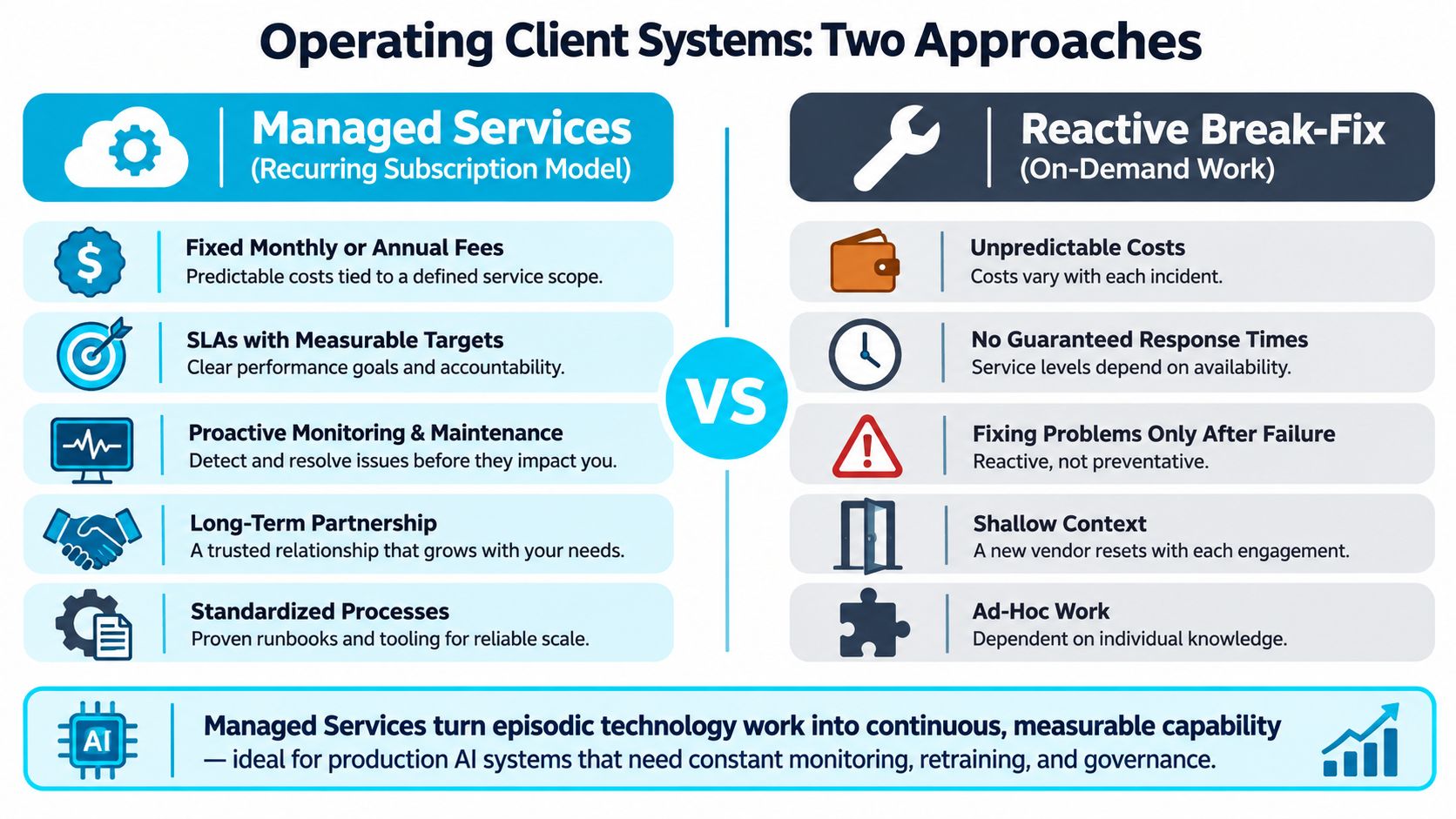
Buy an Operating Obligation, Not Unlimited Requests
The goal is continuity. The accountability should attach to service health, response obligations, recovery procedures, and agreed business measures. The distinction between subscription-based and project-based AI delivery matters because launching a capability and sustaining it require different commitments.
Write the service boundary before onboarding:
- Service catalog: Name the applications, integrations, environments, and support activities covered.
- Service levels: Separate acknowledgment, investigation, restoration, and permanent resolution.
- Exclusions: Identify enhancements, upstream data repairs, and business-policy decisions that need separate approval.
- Escalation authority: State who can suspend an unreliable AI workflow and activate manual processing.
Governance paperwork isn't enough: 95% of surveyed organizations reported an AI-governance policy in the Heidrick & Struggles AI officers report.
The failure mode is contractual ambiguity. A provider can meet a narrow uptime target while users struggle with unusable outputs. Copy this tactic: review service health alongside exception backlogs and business acceptance, supported by runbooks that another engineer can execute.
2. Dedicated Team Capacity Retainer Model
Your procurement roadmap keeps changing, but the need for senior engineering doesn't disappear. Contract extraction needs attention, then approval routing, then an integration with the purchasing system. A dedicated capacity retainer reserves a stable team to work through that evolving backlog.
You're buying access to named capability, not promising a fixed list of outputs indefinitely. Compared with managed services, accountability centers on prioritized delivery and technical quality, unless operational support is explicitly included.
A practical reserved-capacity AI arrangement needs a client owner who can make trade-offs. Without that owner, the team can stay busy while departments compete to get their requests started.
Reserve Capacity Without Creating an Open Queue
Say an engineering firm wants to automate submittal intake while improving internal knowledge search. The client owner ranks those outcomes, the delivery lead identifies dependencies, and both agree on scope and acceptance before implementation. When an urgent request arrives, they decide what moves out rather than adding more work.
- Client owner: Sets business priorities, supplies subject-matter access, and accepts completed work.
- Delivery lead: Owns technical execution, dependency visibility, and delivery risks.
- Capacity review: Compares upcoming needs with the available skill mix and adjusts deliberately.
- Ownership record: Keeps code, configurations, deployment instructions, and documentation accessible to the client.
The trade-off is flexibility versus guaranteed throughput. A stable team retains context, but complicated discovery or an unavailable ERP specialist can still constrain delivery. Reserved capacity doesn't remove dependencies.
The common failure is treating a retainer as unlimited output. Copy this tactic: maintain a visible queue showing work ready to start, blocked work, and accepted deliverables, with explicit decisions whenever priorities change.
3. Project-Based Engagement Model
Use a project when the work has a credible finish line. An ERP migration, a production-data integration, or a proof of concept can have a defined scope, budget, acceptance process, and closing decision. Assemble the required specialists, complete the agreed outcome, and release or reassign them.
For a manufacturer replacing spreadsheet-based quality reporting, the project might deliver validated data pipelines, an approved dashboard, deployment documentation, and an operational handoff. “Explore what AI could do” isn't an equivalent scope because nobody can objectively accept it.
The distinction between continuous delivery and dedicated builds helps separate a bounded initiative from an ongoing improvement backlog.
Handoff rule: A project isn't operationally complete until someone accepts responsibility for running what it produced.
Define Completion Beyond the Demonstration
In Parsec's 2024 manufacturing survey, 76% of manufacturers in North America and Europe had started implementing digital strategies, while 26% had completed their digital transformation initiatives. Starting work and finishing an organizational change are different milestones.
Before delivery begins, specify the test dataset, acceptance criteria, sign-off authority, security requirements, and operational owner. Include access transfer, rollback instructions, monitoring, and training in the actual scope, not in an informal promise to tidy things up later.
The strength is investment control. Leaders can fund a defined outcome and stop after a failed pilot rather than subsidizing indefinite experimentation. The weakness is the incentive to optimize for contractual completion while leaving operating costs elsewhere.
Copy this tactic: require a go, revise, or stop decision after a pilot, with production funding and ownership identified before approving the next phase. Pair the project with continuing support when its output must remain dependable.
4. Platform Operating Model
When engineering, procurement, and operations each build separate integrations to the same systems, a shared platform becomes worth considering. A platform operating model gives teams reusable data, infrastructure, identity controls, APIs, and deployment tooling. Those teams then build their own applications on the foundation.
Azure, Microsoft Fabric, and Power Platform can be components of that foundation. Buying them doesn't establish the operating model; a named platform owner still has to manage users, priorities, interfaces, costs, and support.
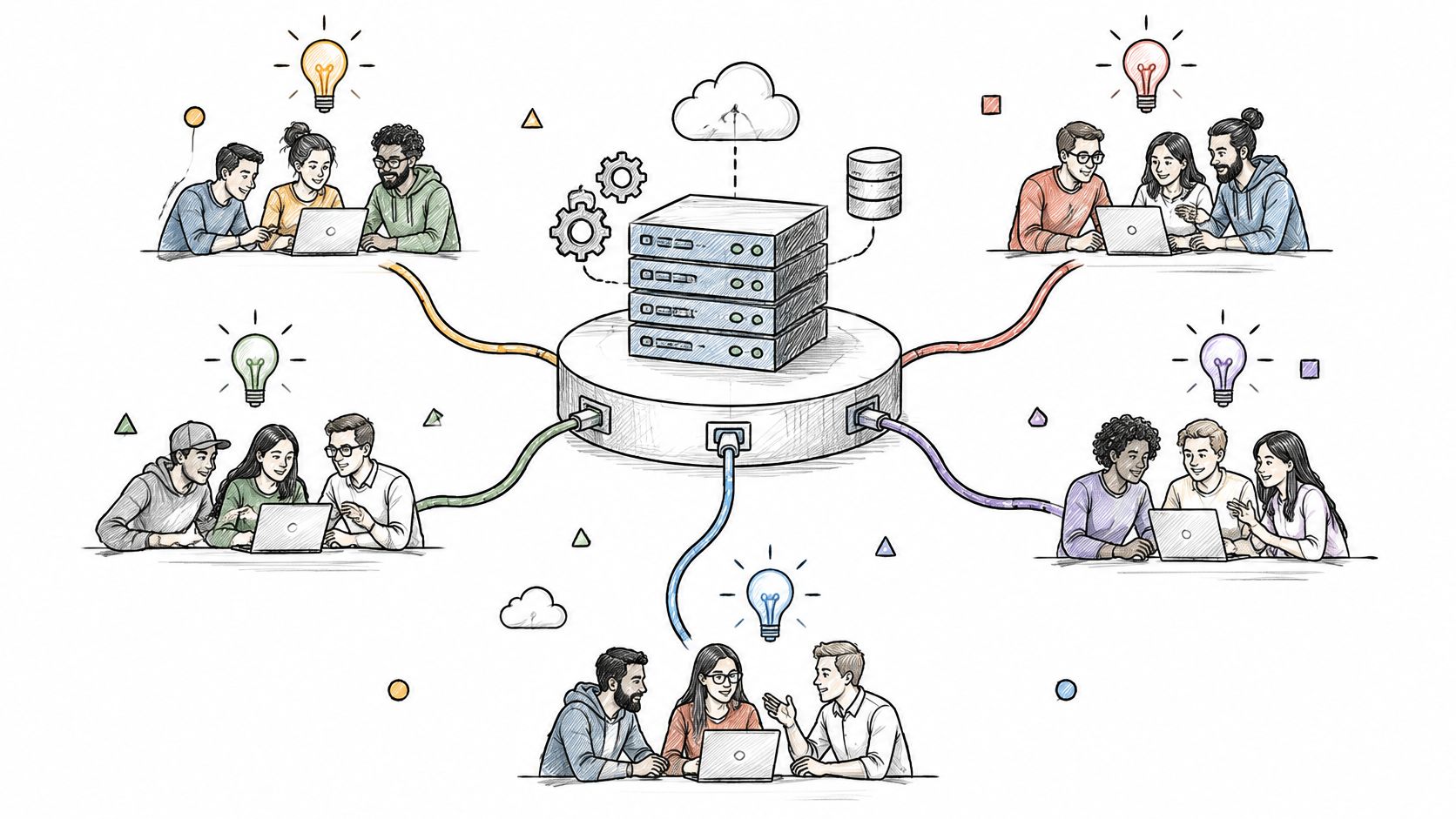
Run the Foundation Like a Product
MIT defines an enterprise IT operating model through accountabilities, processes, platforms, metrics, and behaviors, not technology alone, in its digital business transformation findings. That's a useful boundary: the platform team owns reusable services, while consuming teams own their applications and business outcomes.
For an aerospace organization, the platform might expose approved quality and production data through documented interfaces. A quality team can then build an exception dashboard without recreating identity management or pipeline monitoring.
The failure mode is building a platform nobody can use without opening a ticket. Central consistency becomes a bottleneck when every change requires specialist intervention.
- Publish supported paths: Provide deployment templates, API documentation, sandboxes, and clear access procedures.
- Measure usability: Track adoption, onboarding friction, support requests, and consuming-team satisfaction.
- Control dependence: Keep interfaces documented and data exportable, with portable components where practical.
The trade-off is upfront investment against reuse. Don't standardize every possible requirement before serving a real team. Copy this tactic: onboard a concrete workflow first, then expand the platform around capabilities that other teams genuinely need.
5. Shared Services Operating Model
An accounts-payable team shouldn't need a different intake process for every business unit. Shared services consolidate repeatable work into a common operation, with standard procedures, service commitments, and a named service owner.
Unlike a platform, which enables other teams to build, a shared service performs the work. Finance processing, procurement intake, employee administration, and document routing are natural candidates when their core steps are sufficiently similar.
Standardize the Routine, Design the Exceptions
Toyota's production system connects standardized work, visual control, quality ownership, and continuous improvement, as described by IndustryWeek's account of TPS. Toyota isn't a shared-services example here; its management discipline is relevant because centralizing work without consistent execution rules won't solve inconsistency.
Consider a construction group consolidating invoice intake. The service receives documents, checks required fields, matches purchase orders, and routes exceptions, while project managers retain authority over disputed work and project-specific approvals.
The operating agreement should distinguish those responsibilities:
- Shared-service owner: Owns queue health, processing quality, staffing, and improvement.
- Business-unit owner: Owns approval policy, timely exception decisions, and legitimate local requirements.
- Steering group: Resolves disputes about standardization, service priorities, and investment.
The trade-off is efficiency versus local responsiveness. A uniform process can simplify routine work but mishandle unusual contract terms or urgent site requirements. If exceptions have no legitimate route, employees will create unofficial workarounds.
Copy this tactic: separate the standard processing lane from an explicit exception lane, with named decision-makers and visible aging. Document intelligence can extract and route information, but a human owner must remain accountable for commercial judgment, disputed pricing, and approval authority.
6. Matrix Organization Model
A project manager needs a controls engineer immediately. The functional engineering lead needs the same person to review a safety-critical design. In a matrix model, both demands are legitimate, which is why the decision mechanism matters more than the reporting diagram.
Matrix structures combine functional authority with project, product, regional, or business-unit authority. Engineering and construction organizations can use them to share scarce expertise while preserving discipline standards across multiple engagements.
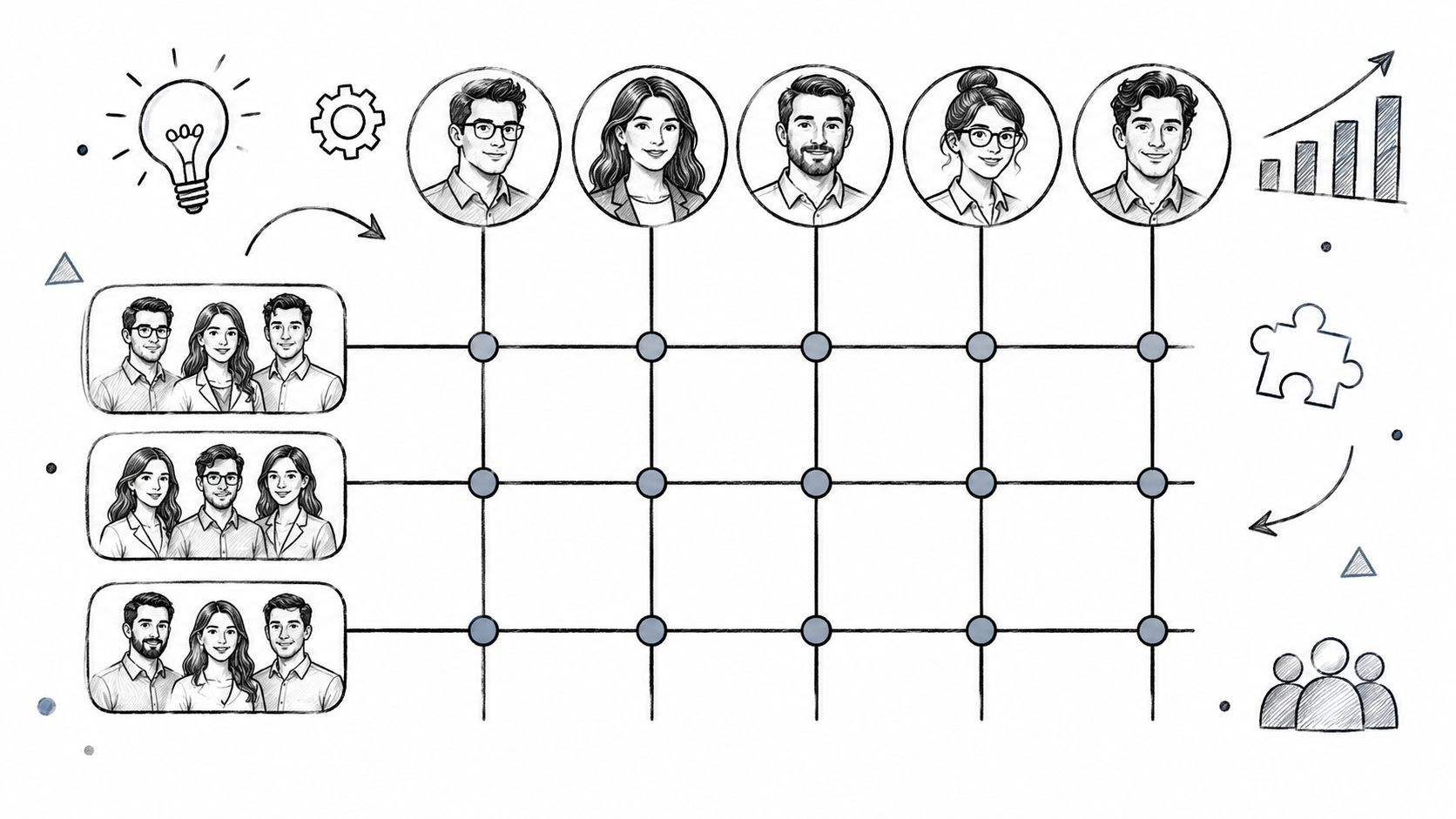
The goal is coordinated specialization. Functional leaders maintain competence, methods, and technical assurance; project leaders coordinate scope, schedule, and commercial delivery. Neither should have to guess where the other's authority ends.
Resolve Conflicts Above the Individual Contributor
For an aerospace program, the program manager might determine delivery priorities within an agreed allocation, while the systems-engineering lead controls technical acceptance. Resource conflicts then go to a named executive sponsor rather than becoming private negotiations with individual engineers.
Don't make an engineer choose which manager to disappoint. Give the managers a decision rule.
The failure mode is accountability without authority. A project manager promises a milestone but can't secure the required people, while the functional manager is judged on standards without sufficient review capacity.
Copy this tactic: document decision rights for staffing, technical approval, scope changes, and priority conflicts. Use joint planning and a shared view of commitments so both leaders see the consequences of reassignment.
Keep the matrix as simple as the work permits. Additional reporting dimensions create more negotiations, not automatically better coordination, and employees need a clear route when instructions conflict.
7. Product-Led Cross-Functional Team Model
A product team stays accountable after release. It owns a long-lived capability, learns from its use, and changes priorities according to outcomes rather than closing a project and dispersing.
For a manufacturer, the product could be a quality-decision service used by plant operators. The team needs engineering, data, operational expertise, and a business owner with enough authority to change the workflow, not merely commission features.
Freeport-McMoRan's Bagdad mine combined process engineers, data specialists, and operations personnel around machine-learning recommendations, moving from plant-setting adjustments once per shift to hourly updates, according to McKinsey's operating-model case study. The relevant lesson is the connection between technical output and a recurring operational decision, rather than evidence that the company adopted a particular product-team framework.
Give Autonomy a Defined Boundary
The goal is sustained business improvement. Accountability covers adoption, decision quality, operational reliability, and the costs of maintaining the capability.
- Outcome owner: Defines the operational result and accepts business trade-offs.
- Cross-functional team: Builds, supports, and improves the product.
- Enterprise authorities: Set mandatory architecture, security, and data-governance boundaries.
The trade-off is local speed versus enterprise consistency. Teams can respond quickly, but unmanaged autonomy can produce duplicate integrations and incompatible controls.
Adoption also needs time: BCG's AI value-gap report found that future-built firms were four times as likely to provide structured learning time. Copy this tactic: put operator training, workflow observation, and feedback into the product backlog alongside technical work.
The failure mode is renaming a project team without changing funding or authority. If executives prescribe every feature and withdraw the team at launch, it doesn't have end-to-end ownership.
8. Build-Operate-Transfer (BOT) Model
A company wants an internal data-engineering capability but doesn't yet have the people or operating procedures to run it. Under build-operate-transfer, a provider establishes that capability, operates it while the client develops readiness, and transfers agreed ownership and responsibilities.
The intended endpoint distinguishes BOT from an ongoing outsourcing arrangement. The provider is not maintaining a service indefinitely; both parties must prepare for the client to take over.
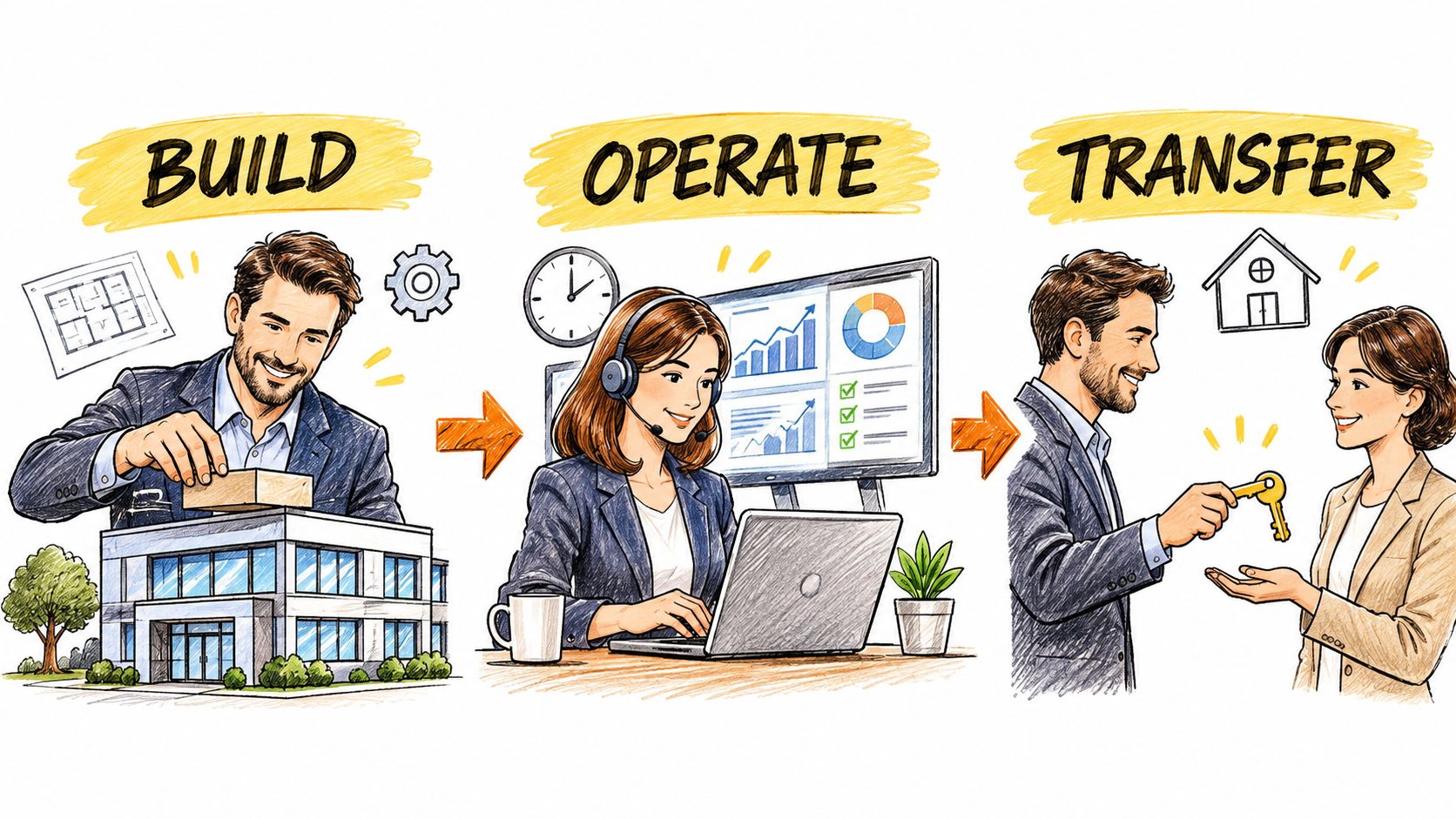
Make Transfer Readiness Observable
Say an industrial company needs a production-data operation. The provider establishes pipelines, monitoring, deployment controls, and support procedures, then gradually shifts incident handling and release responsibilities to client staff.
The goal is eventual self-sufficiency. During the operate phase, the provider owns the contracted delivery and service obligations; the client owns staffing, participation, and readiness decisions. The agreement must state when those responsibilities change.
- Transfer criteria: Define required documentation, access, demonstrated competence, and operational acceptance.
- Ownership throughout: Establish rights to code, configurations, data, and documentation before work begins.
- Staged responsibility: Move from observation to supervised execution, joint operation, and independent operation.
- Continuity provisions: Specify what happens if recruitment slips or transfer acceptance fails.
The trade-off is faster capability establishment against transition complexity. BOT doesn't eliminate investment or management effort; it changes their timing and distribution.
The failure mode is discovering that the provider's expertise lives in individuals rather than transferable procedures. Copy this tactic: have client staff execute deployments, recovery exercises, and support routines before accepting the transfer, with the provider observing rather than doing the work.
How the eight operating models compare by goal, commercial model, and accountability
| Item | Primary Goal | Commercial Model | Accountability | Best For |
|---|---|---|---|---|
| Managed Services (Recurring Subscription Model) | Operate, monitor, maintain, and improve systems continuously | Recurring fee for a defined service scope | Provider is accountable for service levels | Production systems requiring ongoing support and improvement |
| Dedicated Team Capacity Retainer Model | Reserve a consistent team to advance the client's roadmap | Predictable fee for reserved capacity | Shared roadmap governance with named client and provider leads | Sustained work needing specialist talent without permanent hiring |
| Project-Based Engagement Model | Deliver a defined initiative with a clear scope and endpoint | Fixed-price, time-and-materials, or hybrid | Provider delivers agreed scope; client approves milestones and outcomes | Discrete projects, pilots, migrations, and time-boxed research |
| Platform Operating Model | Provide shared foundations for teams to build products and services | Investment and operation of a shared platform | Platform team owns reliability and developer experience; users build on it | Scaling capabilities across internal teams or external partners |
| Shared Services Operating Model | Consolidate common support processes across business units | Centralized costs allocated or charged back to units | Shared service center manages standardized processes and service levels | Organizations seeking consistent, efficient back-office operations |
| Matrix Organization Model | Share expertise across functions, products, or projects | Internal resource allocation across organizational dimensions | Authority is shared between functional and business or project leaders | Complex organizations needing coordination and specialist sharing |
| Product-Led Cross-Functional Team Model | Own products end to end and improve measurable outcomes | Ongoing team funding aligned to products | Long-lived teams are accountable for product outcomes | Organizations seeking faster iteration and clear product ownership |
| Build-Operate-Transfer (BOT) Model | Establish a capability, operate it, then transfer it to the client | Contracted build and operating period with defined transfer terms | Provider leads setup and operations; client assumes ownership at transfer | Building new capabilities or delivery centers without immediate in-house capacity |
Choosing the Operating Model That Fits Your Next Goal
Return to the manufacturer whose AI pilot has stopped updating. The immediate question isn't whether the company should become centralized, product-led, or subscription-based. It's who can investigate the fault, who can suspend recommendations, and who accepts the risk of restarting production use.
Start with the goal, stated as an operational change. Connecting engineering and production records is different from maintaining a live quality system, and both differ from building an internal analytics team. Match the arrangement to that objective rather than selecting a fashionable structure.
Decide Ownership Before Funding the Work
Identify who must own the outcome after go-live. A business owner should accept whether the workflow is useful and safe within its intended scope; a technical owner should accept responsibility for monitoring, support, and controlled changes. Neither responsibility should disappear between a delivery contract and an internal reporting line.
Then decide how the work will be paid for and handed over:
- A bounded deliverable: Use project funding with clear acceptance and operational handoff.
- An evolving roadmap: Reserve team capacity and give a client owner priority-setting authority.
- A dependable live service: Define ongoing service obligations and escalation rules.
- An internal capability: Plan knowledge transfer and demonstrate operational readiness before transition.
Organizations can combine these arrangements without making every team follow the same model. A project can establish a data foundation, a retainer can sustain improvements, and a shared service can operate the resulting document workflow.
At Ryshe, Forge follows a retainer-style model, providing reserved senior capacity and client-owned outputs. Labs handles dedicated, time-boxed builds when an initiative outgrows continuous capacity. The distinction is the shape of the work, not a claim that either arrangement suits every objective.
Foundations matter as much as team structure. Our data platform for an aerospace manufacturer connected seven disconnected systems, giving the organization an integrated basis for production analytics. That kind of work requires ownership of source data, access, interfaces, validation, and ongoing support, not just a dashboard.
Before approving your next initiative, write down the goal, the post-launch owner, the funding arrangement, and the handoff conditions. Then test a failure scenario: the data is wrong, the system is unavailable, or an employee uses it outside its intended scope. If everyone knows who decides and what happens next, you have the beginnings of an operating model you can run.
Ryshe provides production AI, data integration, and automation through reserved senior delivery capacity and separately scoped projects. Visit Ryshe to discuss your next operational goal, the foundations it needs, and who should own it after go-live.