Privacy by Design Principles for Systems and AI
Learn privacy by design as seven principles and eight engineering strategies, then apply them to data workflows and AI before go-live.

Privacy by design means specifying collection, access, retention, and disclosure limits while a system is being architected, so the default path exposes the least personal data that still does the job. Its eight engineering strategies turn that intent into controls teams can build, test, and maintain.
The popular advice to follow a principles checklist isn't enough. A design can pass review while a support export, retrieval index, or forgotten queue exposes information the application carefully restricts. For engineering and operations leaders, the useful question is whether the privacy requirement survives every integration, and who fixes it when it doesn't.
Why Privacy Controls Belong in the Architecture
Adding a privacy notice after a system is built isn't privacy by design. Say an engineering firm builds a contract-processing service that copies every uploaded document into a shared search index. A notice explaining that collection doesn't change the index's permissions, remove unnecessary personal details, or establish when copies disappear.
The architecture must specify what the service may collect, who may see it, how long it stays, and when it must be deleted. Think of a house: fitting locks while the walls are open is design. Attaching padlocks after construction is remediation, sometimes necessary, but constrained by decisions already made.
The original insight was an engineering choice
The historical account of privacy by design traces its roots to mid-1990s privacy-enhancing technology research, including the joint Ontario and Dutch report published in 1995, Ann Cavoukian's subsequent development of the framework, its presentation to regulators in 2009, and unanimous recognition as an international standard in October 2010. The report's central insight remains practical: systems could deliver comparable functionality with no personal data, or substantially less of it.
That changes the design conversation. Instead of asking how to protect every field available from a source system, engineers first ask which fields the business function needs.
Architecture test: If a field disappeared, would the intended business function stop working? If not, justify collecting it before adding protection around it.
For the contract service, a routing task might need the project identifier, document type, and responsible team. It might not need a signatory's home address or a personal telephone number embedded in the attachment.
AI and integrated platforms make these choices consequential because the initial upload can feed prompts, logs, queues, indexes, and backups. An architect should draw those destinations before implementation, rather than treating the application database as the whole system. A privacy requirement that ends at an API boundary doesn't protect the downstream workflow.
Seven Principles That Change System Design
| Principle | Design rule | What changes in the system |
|---|---|---|
| Proactive not reactive | Anticipate misuse before launch | Threat cases and data-exposure paths enter the design rather than a post-incident patch |
| Privacy as the default | Collect and expose only what the purpose needs | Deny-by-default access and protective settings remain active unless an authorized change occurs |
| Privacy embedded into design | Build controls into architecture | Schemas, APIs, storage boundaries, prompts, and logs carry the limits |
| Full functionality | Keep the business outcome | Deliver the same job with fewer fields, separation, or aggregation rather than dropping the feature |
| End-to-end security | Protect data for its whole life | Encryption, access control, and deletion cover transit, rest, replicas, and backups |
| Visibility and transparency | Make processing explainable | Purpose, categories, recipients, and retention are documented and reviewable |
| Respect for user privacy | Treat rights as product features | Access, correction, and deletion work across systems holding copies |
Read these principles as review questions, not aspirational labels. Proactive means documenting how someone could misuse a feature before approving it. For an assistant, that includes a malicious instruction inside a retrieved document that attempts to pull personal information into the response, one of the AI security issues a design review should address.
Privacy as the default concerns what happens when nobody changes a setting. It's different from offering an administrator a privacy option buried in a configuration screen.
Separate the framework from the legal obligation
Under the analysis of GDPR Article 25, data protection by design and by default became an explicit legal obligation when the GDPR began applying on 25 May 2018. Controllers must implement appropriate technical and organizational measures when determining processing means and throughout processing, considering technology, implementation cost, context, purpose, and risks to individuals.
The obligation can also reach organizations outside Europe that offer goods or services to people in the EU or monitor their behavior. It doesn't mean every organization must buy the same technology, and it doesn't turn the principles table into a universal compliance certificate. Teams need defensible, reviewable decisions appropriate to their processing.
Embedded design makes those decisions executable. A schema can reject unnecessary fields, while an API can enforce a caller's permitted purpose rather than trusting a front-end screen to hide restricted information.
Preserve function and make protection verifiable
Full functionality asks engineers to challenge unnecessary trade-offs. A project-volume dashboard may work with grouped results instead of named employees; removing names needn't remove the dashboard's usefulness.
End-to-end security prevents the team from declaring success because the primary database is encrypted. The protection must extend to the data's full lifecycle.
The remaining principles determine whether people can understand and challenge the processing:
- Visibility and transparency: An operator can explain which information supported an output and why it was available.
- Respect for user privacy: A request for access, correction, or deletion reaches an accountable workflow, not an unattended mailbox.
A principle becomes useful when the reviewer can identify the system behavior that would prove or disprove it.
Eight Strategies That Make Principles Measurable
ENISA's analysis of data protection in big-data architectures identifies eight complementary strategies: minimize, hide, separate, aggregate, inform, control, enforce, and demonstrate. They connect broad principles to implementation choices, without pretending that privacy can be reduced to a universal score.
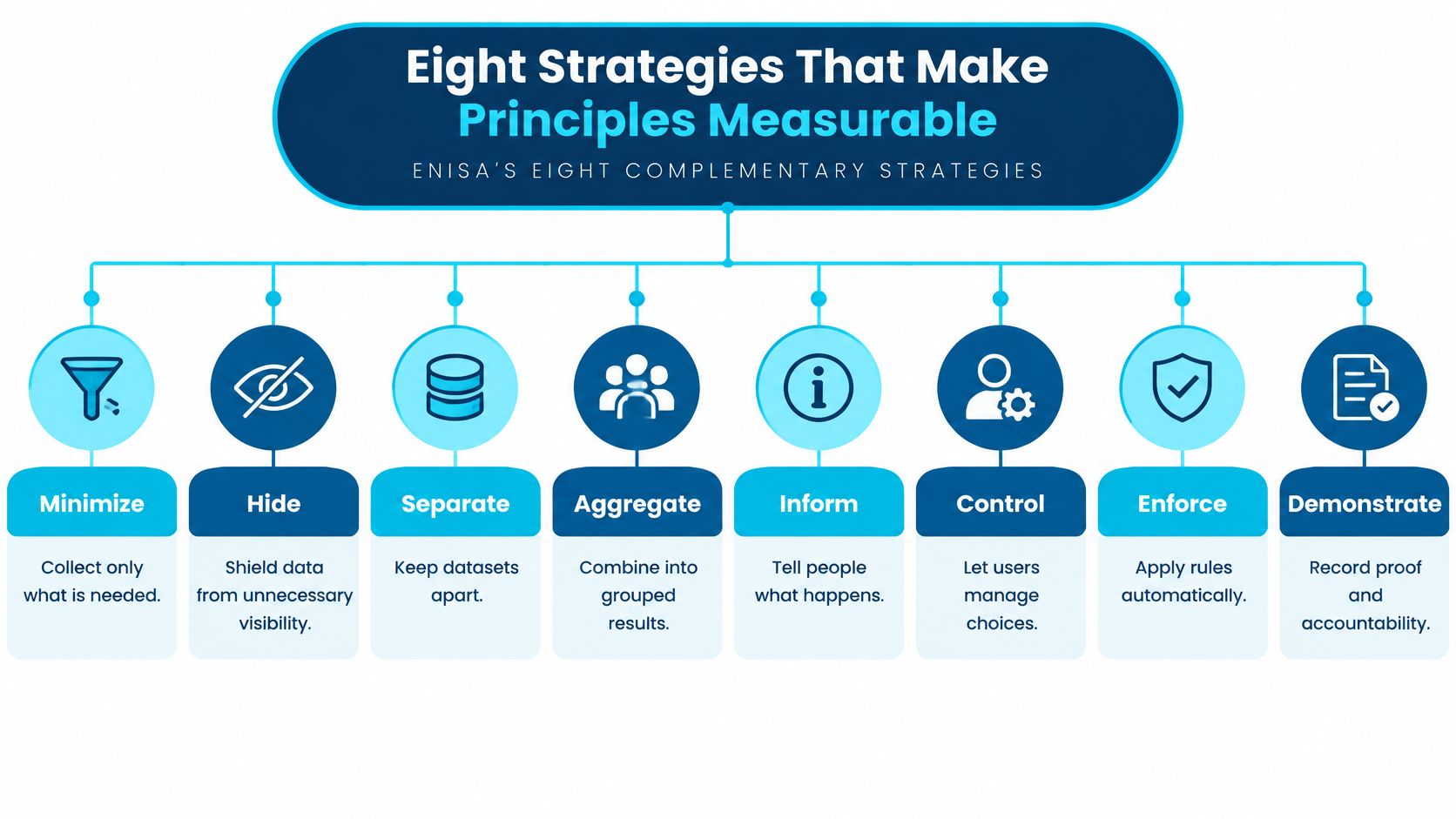
| Strategy | Control to build | Acceptance signal |
|---|---|---|
| Minimize | Field allowlist per business purpose | Share of extracted fields justified by that purpose |
| Hide | Encryption in transit and at rest; identifiers excluded from logs | Sensitive fields absent from logs and unprotected stores |
| Separate | Identity attributes stored apart from operational records | Linkage testing checks whether operational records reveal identities without the identity store |
| Aggregate | Counts or ranges instead of unnecessary individual rows | Individual-level fields removed from analytics that don't need them |
| Inform | Documented purpose, categories, recipients, and retention | A reviewer can explain what was used and why |
| Control | Purpose- and role-based access plus rights workflows | Unauthorized-access events and data-subject request completion time |
| Enforce | System-applied policy with default denial | Attempts outside role or purpose are blocked |
| Demonstrate | Immutable access logs and retained design evidence | Retention violations and re-identification test results are reported |
Measure a property, not a promise
Start with equivalent business functionality. Comparing an unrestricted analytics service with a service that cannot answer the required question won't tell you whether the privacy architecture works. Compare implementations that deliver the intended outcome, then assess the privacy properties that matter.
Minimization reduces the data available for exposure. Separation reduces linkability. These aren't interchangeable: removing a name doesn't necessarily prevent identification if the remaining attributes distinguish an individual.
For a document-intelligence workflow, define the extraction allowlist before configuring the model. Redact unnecessary personal information, isolate tenant storage, set purpose-specific retention, and connect deletion jobs to that purpose's end condition. Give logs a retention policy too; immutable shouldn't mean retained forever.
Evidence is more useful than a green checkbox. Keep the test input, expected behavior, observed result, and accountable owner.
Turn acceptance signals into runnable tests
Useful measures include the percentage of extracted fields justified by purpose, retention-policy violations, unauthorized-access events, re-identification test results, and time to complete a data-subject request. Define how each is calculated so teams don't report incompatible measures under the same label.
For example, the field-justification measure should inspect actual extracted output, not merely the documented schema. Otherwise, free-text fields can carry personal information while the allowlist appears compliant.
Distinguish a blocked unauthorized attempt from a successful unauthorized disclosure. Both deserve monitoring, but they indicate different conditions. A release record should identify the tested privacy property, the relevant dataset or workflow, and the evidence supporting acceptance.
How to Gate Privacy From Design to Release
The Information Commissioner's Office guidance requires appropriate technical and organizational measures from design through processing, with defaults that prevent personal data from being available to an indefinite audience without the individual's intervention. Treat this as a continuing delivery obligation, not a document signed at project kickoff.
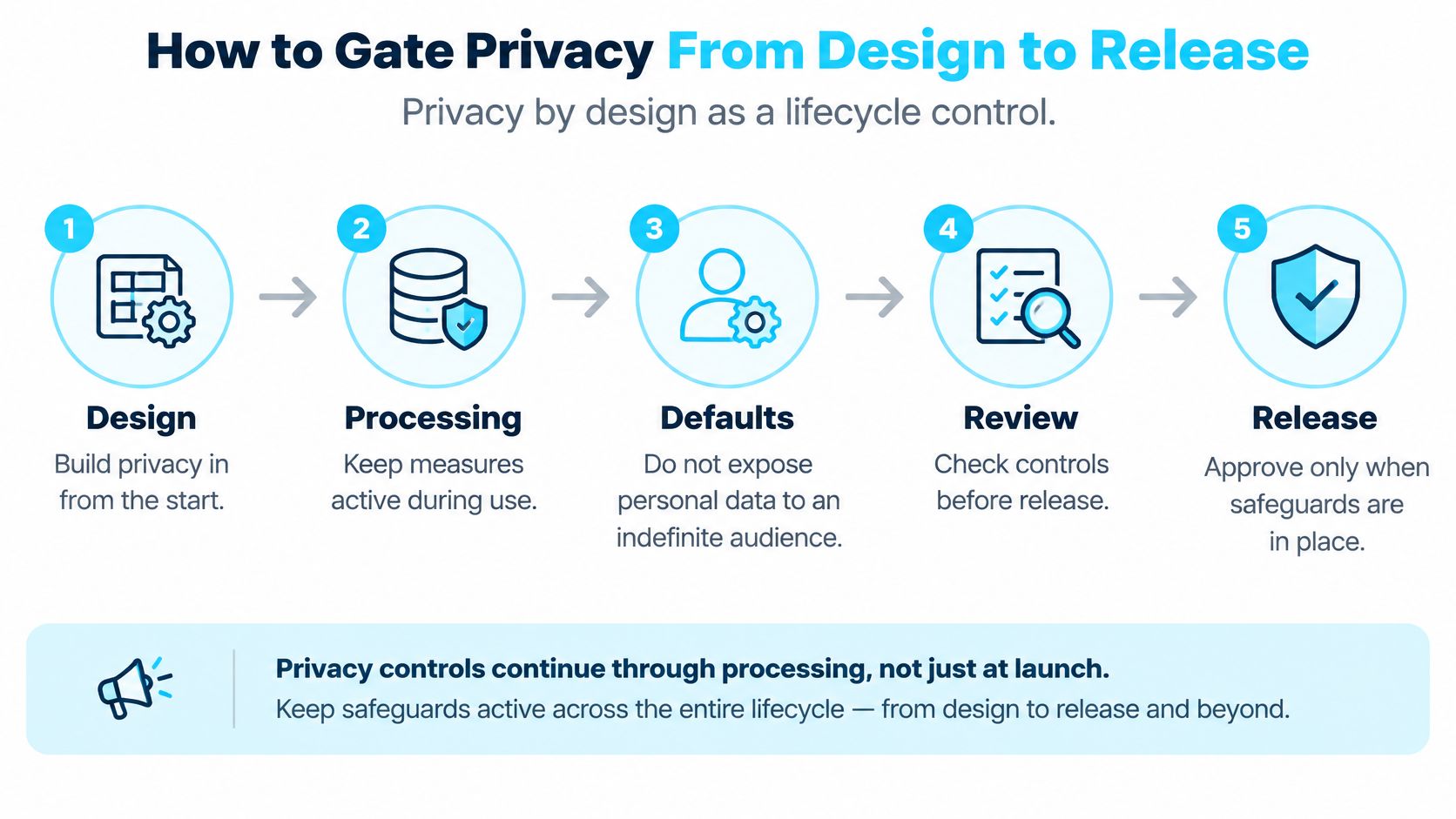
Use explicit delivery gates
The lifecycle above needs concrete release decisions. A practical implementation uses the following gates, with an owner authorized to stop work when evidence is missing.
Assess before selecting architecture. Run a privacy impact assessment before committing to data sources or a model approach. Stop if the purpose or risks remain unclear; otherwise, the team can optimize an architecture for processing it shouldn't perform.
Write processing requirements into the specification. Record purpose, lawful basis, data categories, recipients, retention, and user rights. Skipping this leaves developers to infer policy from source-system availability, which isn't a valid statement of need.
Approve the initial configuration. Use deny-by-default access, least-privilege service identities, and pseudonymized identifiers in development. Require explicit approval for secondary use; without it, a convenient integration can become a new processing activity.
Implement structural safeguards. Encode limits in schemas, APIs, storage boundaries, prompts, logs, and training pipelines. Leaving these decisions until deployment can require data migration, retraining, and retroactive deletion rather than a simple configuration change.
Define human review for high-impact outputs. Specify who reviews outputs used for consequential decisions about people, what evidence they receive, and how they reject or escalate a result. An undefined review step can become routine approval without meaningful scrutiny.
Require privacy acceptance tests before release. Verify authorization behavior, deletion handling across replicas and backups, audit-log completeness, retention enforcement, and the ability to explain data use. Accuracy testing alone won't reveal that an otherwise correct answer included information the caller wasn't allowed to receive.
Schedule re-testing and change-triggered review. Reassess when integrations, vendors, or purposes change, as well as on a defined schedule. Skipping this lets the deployed system drift beyond the assumptions supporting its original approval.
Test recovery behavior as well as normal operation
Deletion testing needs particular care. A backup may not support immediate record-level removal, so document its isolation, expiry, and restore procedure rather than claiming every copy disappears instantly. Test that restoring a backup doesn't return deleted information to ordinary use.
Build reusable components for permission management, minimization, secure sharing, transparency, and rights handling. Assign each component an interface and test suite so application teams can use it without recreating policy from memory.
The release decision should name unresolved exceptions and their owners. If an essential safeguard fails, record a blocked release rather than accepting an undocumented promise to repair it afterward.
Where Controls Land in Documents Data and AI
A document service must account for its search index
Say a contractor automates submittal intake. The extractor returns only approved fields, the redaction stage removes personal details irrelevant to routing, and tenant boundaries prevent another customer's documents from entering the result set.
The hidden failure is the search connector. It may index the original attachment even though the application stores only the approved extract. The team's data governance framework should make that derivative copy visible, with its own permissions and lifecycle.
Proof test: Submit a deletion request for a synthetic record, then confirm its removal from extracts, search results, caches, and applicable replicas. For isolated backups, verify the documented expiry and restore controls.
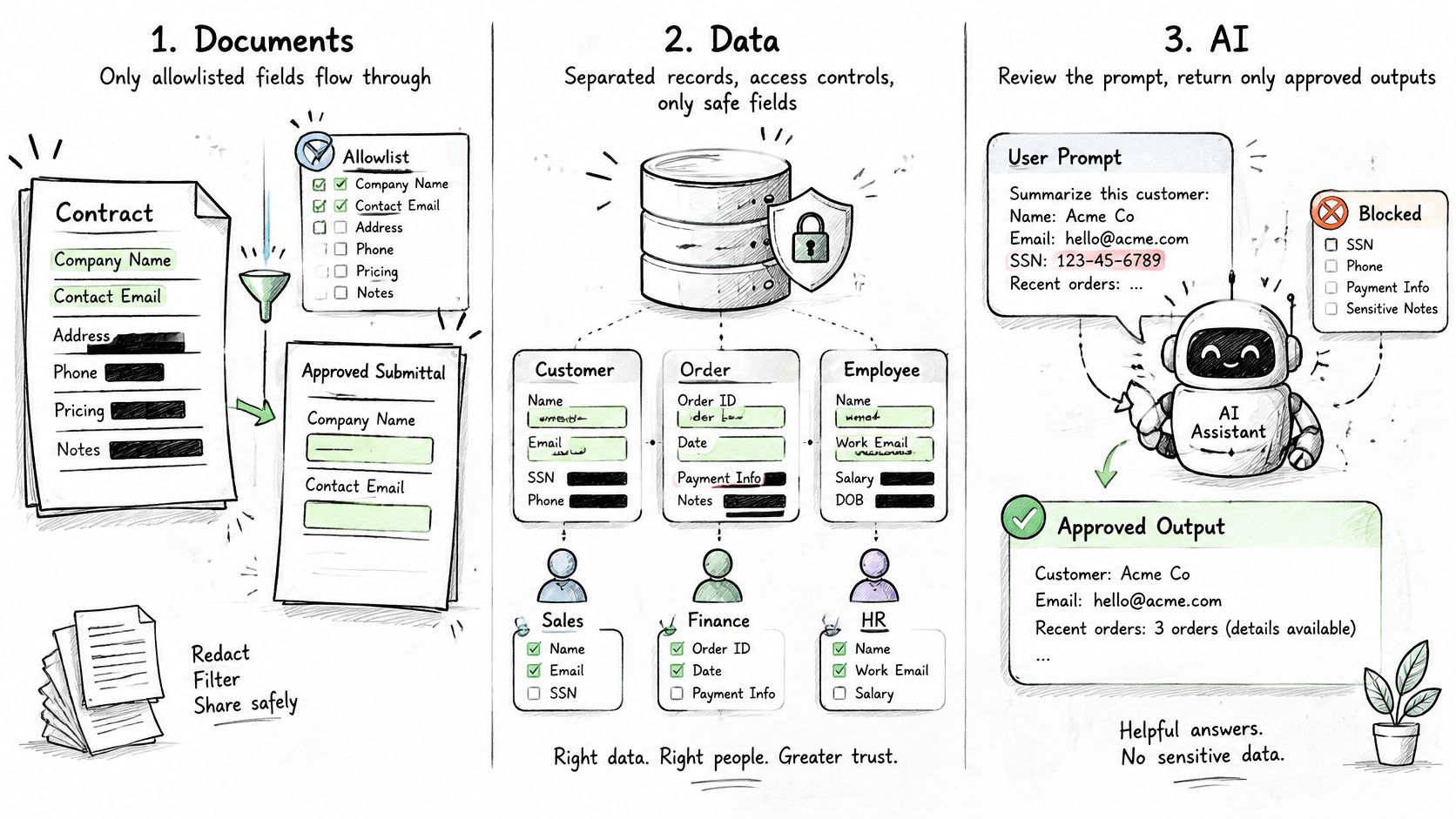
A pipeline must protect diagnostic traffic
Consider a manufacturer joining procurement and quality records. Development uses pseudonyms, dashboards receive grouped results where names aren't needed, and quality checks, monitoring, alerting, and error handling are part of the pipeline from the start.
An error handler can undermine that design by copying a rejected raw payload into a dead-letter queue. For teams reproducing traffic during debugging, GoReplay data masking guidance is a useful implementation resource when planning how to keep sensitive payloads out of test environments.
Proof test: Attempt to re-identify people in the aggregate output using reasonably available contextual information. Check small groups and unusual combinations rather than assuming that removing names makes the output anonymous.
An assistant must authorize retrieval before generation
An internal engineering assistant should use the minimum corpus needed for its task. Enforce document permissions before retrieval results reach the model, and include prompts, conversation history, and diagnostic logs within the privacy boundary.
A model instruction to keep information confidential isn't an authorization system. Don't allow a broadly privileged retrieval service to fetch restricted material and rely on the assistant to withhold it afterward. Reusing conversation outputs to train another model should require an approved new purpose, not a quiet copy of the log store.
Proof test: Ask an out-of-role question through conversational manipulation, then verify that the retrieval layer withheld restricted records and the response disclosed none of their contents. Check traces too, because an apparently safe answer can conceal an unauthorized retrieval.
A passing demonstration proves little if support tools, exports, and third-party processors remain outside the test boundary.
Across these scenarios, test failures often originate in destinations the team never put on the data map. The owner must be able to follow a record beyond the application that first collected it.
Keep Privacy Owned After Launch
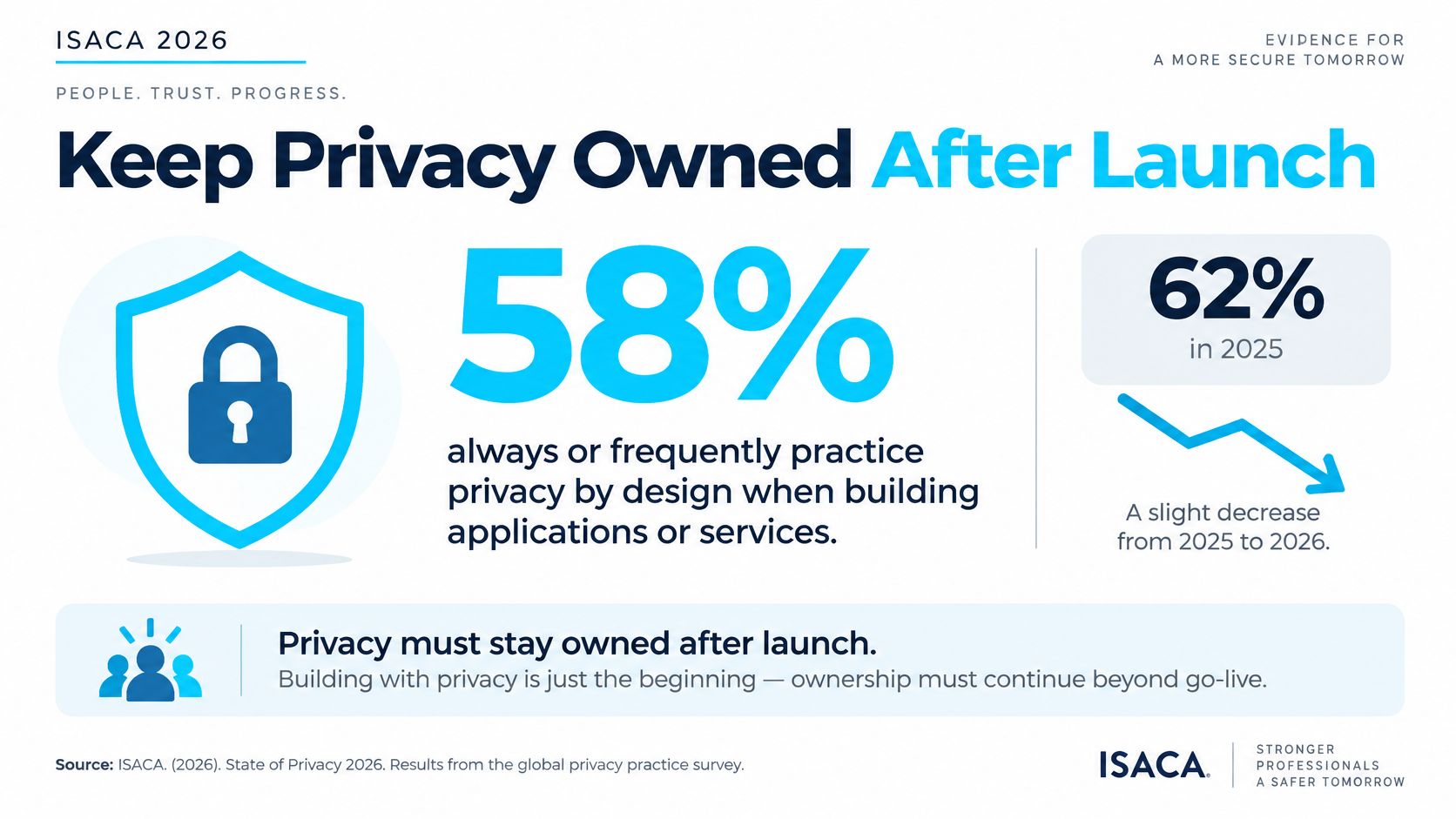
In ISACA's 2026 privacy survey, 58% of surveyed organizations always or frequently practice privacy by design when building applications or services, down from 62% in 2025, while 47% of respondents say their technical privacy teams are understaffed. Technical expertise remains the leading privacy skills gap.
Those findings don't establish when individual programs fail. They do make it risky to assume that a completed review guarantees sustained implementation. The operational question is who owns privacy decisions after launch, and what triggers another review.
Make governance small enough to execute
Healthcare workflow research published in PLOS Digital Health describes barriers including time pressure, unclear guidance, insufficient training, and legacy-system constraints. Treat those as delivery constraints to resolve, not reasons to circulate another policy document.
A mid-sized organization can start with a focused operating model:
- Name accountable owners. Give the product owner authority over business use and the data owner responsibility for permitted handling. Specify who can refuse a proposed reuse.
- Maintain a living data map. Include legacy systems, logs, queues, backups, analytics, support tools, exports, and processors, not just production databases.
- Define review triggers. Require review for a new purpose, integration, vendor, model, logging destination, export destination, or jurisdiction.
- Automate policy checks. Put schema validation, permission tests, retention checks, and sensitive-log detection into the delivery pipeline.
- Require an exit path. Document rollback and deletion procedures before a change ships, including how downstream recipients are handled.
For international programs, evaluate jurisdiction changes explicitly. Don't assume that a configuration approved for one operating context remains appropriate everywhere.
Put ownership inside ordinary change management
An AI governance framework should connect these decisions to the people approving deployments and operating services. A separate privacy register won't help if engineers can change an export destination without consulting it.
At Ryshe, we treat CUI classification, access controls, and audit trails as architectural requirements, not add-ons. CUI handling and personal-data privacy aren't identical obligations, but both need explicit boundaries. During data foundation work, we design and implement architecture, pipelines, and governance as fully documented infrastructure-as-code.
Handoff must preserve control as well as documentation. Our clients own their data, code, configurations, documentation, and client-specific work product; we retain our pre-existing frameworks and accelerators. Operational maturity depends on sustained ownership inside change management, not merely advanced privacy-enhancing technology.
Pick a system about to gain an AI feature and complete this owner review:
- Purpose: State the business outcome and prohibited secondary uses.
- Minimum fields: Name the necessary inputs and excluded information.
- Retention: Specify the retention period, deletion trigger, and verified deletion path.
- Owner: Name the person authorized to refuse a new use and block release.
A blank owner or unnamed deletion path blocks the feature. Make that a release condition, not an observation in meeting notes.
Ryshe builds production AI, data integrations, and automation with governance, monitoring, documentation, and written acceptance criteria. Visit Ryshe to discuss a system approaching an AI release and define the data boundaries, privacy tests, and operational ownership it needs before launch.