What Is Purchase Order Management: Steps and Controls
Learn what is purchase order management, from approval controls to the metrics that keep buying approved, matched and traceable.
Month-end closes on Thursday. Accounts payable holds an invoice for 480 bearings, and the buyer who placed the order is on a customer site with no signal. The only record of what was agreed is an email thread and a photo of a quote. Someone has to decide whether to pay it, and nobody can say for certain what was approved, what arrived, or what price was agreed.
That decision, made badly and at speed, is why purchase order management exists. A purchase order is not paperwork. The management around it is the difference between a company that knows what it committed to and one that reconstructs the month afterward.
Think of a workshop. No machinist starts cutting until a work order is written, approved and signed. The finished part is then checked against that work order before the invoice goes out. Buying runs on the same two checks, and the firms that struggle are almost always missing one of them.
What a Purchase Order Really Does for a Business
Purchase order management is the controlled, end-to-end handling of a purchase order, from approved demand through supplier fulfillment and financial settlement. That's the working definition in the object-centric process-mining research published in Springer's journal. The document itself is created after a supplier is selected and records the goods or services, the prices and the delivery terms. The management is every event that touches it afterward.
The plain answer to the question of what is purchase order management starts with three documents people mix up.
A purchase order is not a requisition and not an invoice
A purchase requisition is an internal statement of need, raised before anyone commits to a supplier. The purchase order is the commitment itself, issued to a named supplier with prices, quantities and terms. An invoice is the supplier's claim for what they delivered.
Confuse the first two and you approve appetites instead of spend. Confuse the last two and you pay claims you never agreed to. That second error is the expensive one, because the money has already left.
Say a plant buyer raises a PO for 500 bearings at a quoted unit price. The shipment lands with 480 in the crate. The invoice bills 500 at a higher price than the quote. Nothing in the delivery paperwork resolves that. Only the PO record shows what was authorized, which turns the gap between 480 and 500 into a documented variance rather than an argument.
The four movements below are what a purchase order record has to cover.
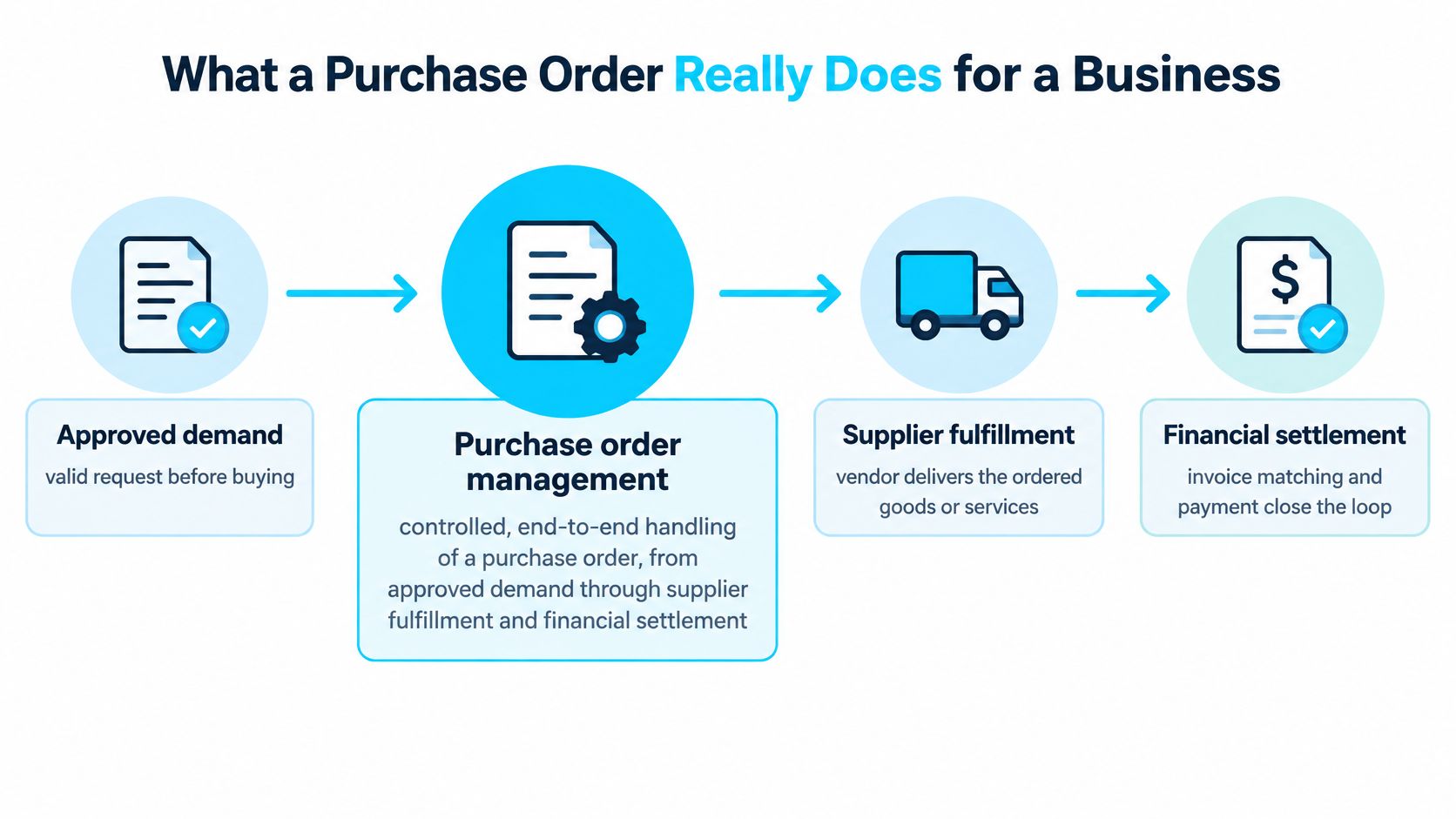
This is why a PO outranks a simple order form. It's a transaction-control document linking purchasing, receiving, accounts payable and supplier performance. It preserves a traceable record of who requested, approved, issued, changed, received and paid for each commitment, and that trail supports budget control, blocks unauthorized purchasing, reconciles invoices against ordered and received quantities, and feeds delivery-reliability data back into supplier reviews.
The test that matters: pick any purchase from last quarter. If you can't answer who authorized it, what arrived, whether the invoice matched and where the record lives without emailing a person, you have documentation rather than control.
The sequence holds for services as well as goods. A structural engineering consultant billed by the hour and a crate of bearings both move through request, approval, order, receipt, invoice and payment. Test your own process against those six words and you'll know quickly which half you have.
The Purchase Order Lifecycle From Request to Closure
A purchase order lifecycle is a state machine, not a form. Each stage either produces the evidence the next stage needs or sends the request back. The high-precision manufacturing case study published in MDPI's Logistics journal describes the sequence as requisition validation, budget and policy approval, supplier and catalog validation, PO creation, transmission, supplier confirmation, delivery monitoring, goods receipt, invoice matching and archival.
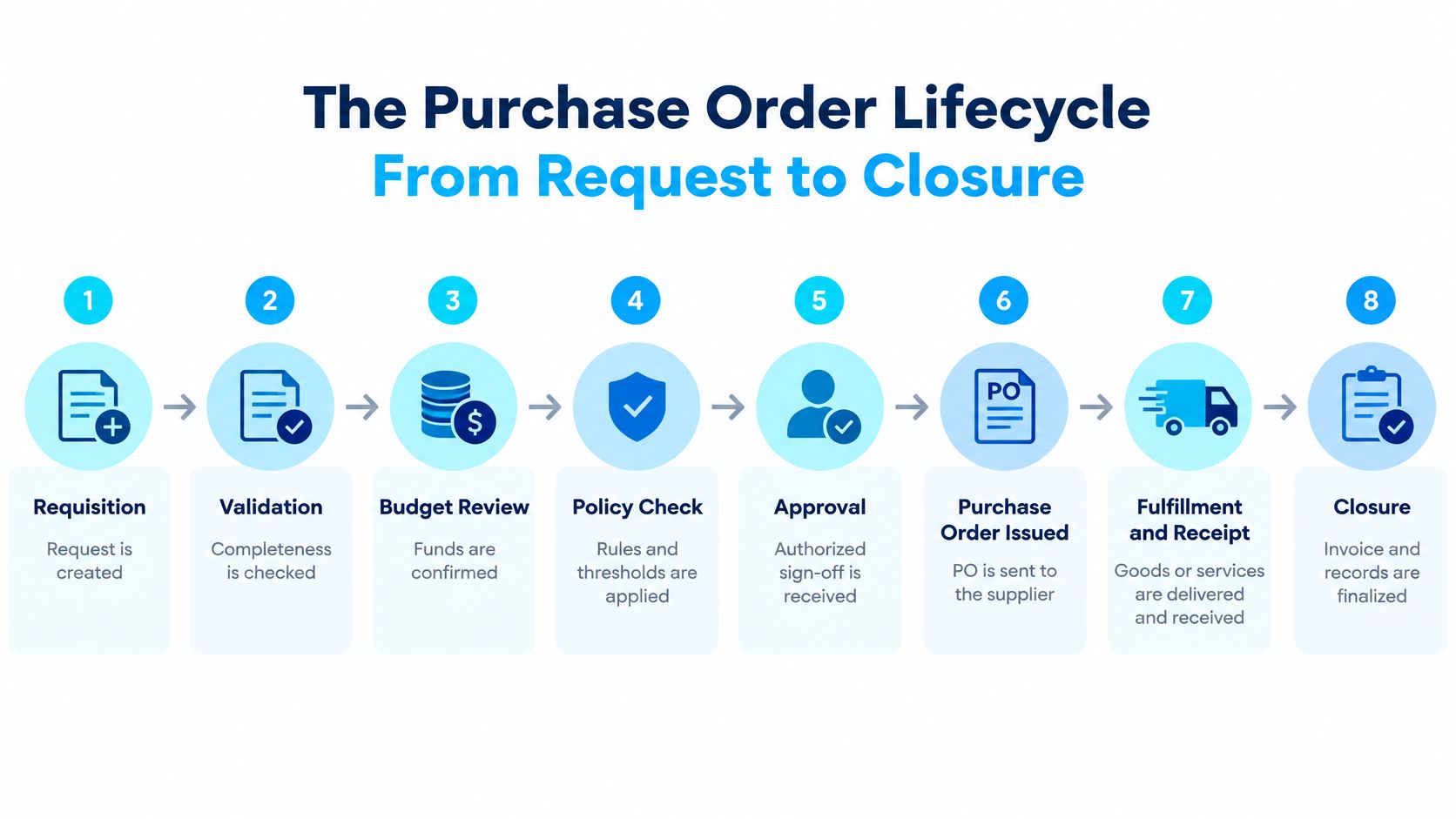
Laid out with owners, those eight stages look like this.
| Stage | What Happens | Typical Owner |
|---|---|---|
| 1. Requisition | Need is written up and checked for completeness | Requester |
| 2. Approval | Budget and policy approval, with director sign-off above EUR 1,000 | Budget owner and finance |
| 3. Supplier validation | Supplier and catalog checked against the approved list | Procurement |
| 4. PO issue | PO created and transmitted to supplier and ERP | Procurement and system |
| 5. Acknowledgment and changes | Supplier confirms; any change is versioned against the original PO | Procurement and supplier |
| 6. Goods receipt | Quantities received recorded against the PO | Receiving |
| 7. Invoice matching | Invoice checked against PO and receipt | Accounts payable |
| 8. Payment and closure | Payment released, PO closed and archived | Finance |
How the controls fire on a real order
In the manufacturing case, incomplete requisitions route back for correction instead of sitting in an approver's queue. Finance and purchasing validate each request, orders above EUR 1,000 require director approval, and compliant POs transmit automatically to the ERP and to the supplier.
The design point is timing. Authorization rules execute before commitment, not during invoice review, which is the difference between preventing uncontrolled spend and discovering it. The same structure creates an auditable link between the request, the approved supplier terms, the ordered quantity, the receipt and the invoice.
The study estimated that digitizing approval, validation and transmission cut order lead time from 7.0 working days to 1.75 days, a 75% reduction. Treat that as a modeled process estimate rather than measured transaction timestamps, which is how the authors present it.
Practical rule: never let a PO leave your system without an acknowledgment deadline attached. An unacknowledged order is a guess about what the supplier thinks you bought.
Mapping your own process
Lay your current flow beside the eight rows and mark where a request stops. Many teams find two or three stages running on memory: no receipt record at stage 6, no versioning at stage 5, no archival at stage 8. Those gaps are what a workflow build has to close first. Teams that want to see how the forms and routing layer fits together can start from this Closer Innovation Labs Corp. tutorial on assembling a lightweight purchase order system, then replace the manual steps as volume grows.
Approval and Control Rules That Prevent Unauthorized Spend
The clearest statistical split between strong and weak purchasing operations is electronic approval. APQC defines the metric as the percentage of purchase orders approved electronically through internet-based systems or EDI, and benchmarked it across 4,472 companies. Top performers electronically approved 98% of purchase orders, while bottom performers approved only slightly more than half, according to the APQC benchmarking comparison reported by SDCExec.
That gap carries real weight. Electronic approval produces a timestamped, searchable authorization record and routes requests by value, department, project or budget authority. Paper and email chains hide who approved what, and they make exceptions hard to spot until an invoice turns up.
Six controls and the failure each one blocks
| Control | What It Prevents | Example |
|---|---|---|
| Value-based approval thresholds | Spend committed without budget authority | Orders above EUR 1,000 need director approval |
| Electronic approval with timestamps | Undocumented or email-based sign-off | Approval recorded with approver name and time |
| Supplier and catalog validation | Purchases from unvetted vendors | Order blocked when the supplier is not on the approved list |
| Role-based editing rights | Post-approval changes by the wrong person | Price change forces buyer re-approval |
| Three-way matching | Paying for goods not ordered or not received | Invoice paid only when PO and receipt agree |
| Immutable status history | Unexplained changes after the fact | Every amendment linked to the original PO version |
Read the table as a set of tripwires rather than features. A supplier validation rule stops an order because the vendor isn't on the approved list, and that one block prevents an unvetted supplier's invoice from ever reaching accounts payable. Role-based editing means a buyer's post-approval price change drops the order back into the approval path rather than sliding through unchecked.
If you're building or auditing this control set, the COSO framework controls review from AmbitionCFO sets out how to document an internal control environment so approval rules survive an audit, not just a busy quarter. For teams automating the routing layer itself, a worked example of an Azure Logic Apps purchase order approval integration shows how thresholds, approvers and status records get wired together.
A threshold that clears low-value, low-risk buys without ceremony is what makes scrutiny of the remaining ones real. If everything needs approval, nothing gets read.
Use the 98% figure as a baseline rather than a badge. Measure your own electronic approval share, then open the file on every manually routed order and ask why it went that way. The answer is usually a missing delegate, a threshold set too low, or a route that defaults to a person instead of a rule.
Exceptions, Mismatches and Who Owns the Fix
The document is the easy part. What consumes a procurement and AP team's week is the mismatch: quantities, prices, units of measure, tax treatment, partial receipts, substitutions, late change orders and invoices that reference the supplier's own numbers. Treating PO management as document creation skips exactly the work that costs money.
The mismatch is material, not occasional. A 2025 finance and procurement benchmark reported an average invoice-processing time of 8.2 days and a 14% exception rate, and a separate survey found that 59% of finance and procurement leaders learned about purchasing-policy noncompliance only after the transaction, per PwC's global digital procurement survey.
Two-way matching versus three-way matching
Two-way matching compares the PO to the invoice. It catches price creep and duplicate billing, and it does nothing about goods that never arrived. Three-way matching adds the receipt, so a payment clears only when what was ordered, what was received and what was billed all agree.
That third record is where most programs are thinnest. If the person taking delivery has no quick way to record it, receipt gets rebuilt from memory days later, and you're running two-way matching while believing you run three-way. Capturing receipt discipline and the mechanics of catching billing errors in AP turns a mismatch into a routed exception instead of an investigation.
Who owns each exception
| Exception | Typical Cause | Rule to Set | Owner |
|---|---|---|---|
| Quantity variance | Partial shipment or over-delivery | Tolerance band in units or percent | Receiving with buyer |
| Price variance | Invoice above agreed unit price | Auto-pass within tolerance, otherwise hold | Accounts payable |
| Unit or tax mismatch | Different units of measure or tax treatment | Master-data rule for units and tax codes | Finance with master-data owner |
| Substitution | Supplier ships an alternative item | Buyer approval before payment | Procurement |
| Change order after issue | Scope or date changed late | Amendment linked to the original PO | Buyer |
| Duplicate supplier record | Same vendor entered twice | Single governed vendor master | Master-data owner |
An exception without a named owner is a queue. A queue without a tolerance rule is a backlog with a deadline attached.
Workflow tools can't repair a broken vendor master or settle an undefined tolerance policy, and buying automation before settling ownership just moves the argument to a faster system. Pair this with a clear view of what invoice processing covers so the boundary between procurement's exception and AP's exception is written down rather than negotiated per invoice.
Measuring Whether Your PO Process Works
Averages hide the problem. In one procurement-process study, 26.9% of respondents reported that converting requisitions into purchase orders took more than seven days. Only 6.5% completed the conversion within three hours, while 61.1% finished within two days, according to the IEOM Society proceedings.
That distribution is a long tail, not a slow average. A fast path coexists with approvals, missing data, supplier checks and exceptions, and the tail is where the cost sits. Segment cycle time by workflow stage and the bottleneck becomes visible.
| Metric | What It Reveals | Pattern to Watch |
|---|---|---|
| Requisition-to-PO time (median and 95th percentile) | Typical speed and the slow tail | Long tail above seven days |
| Approval aging | Approvals stuck with one person | Items waiting beyond the agreed limit |
| First-pass completeness | Requisitions returned for missing data | Rising returns after a form change |
| Supplier confirmation latency | Orders with no supplier acknowledgment | Confirmations overdue by agreed days |
| PO change frequency | Unstable scope or weak specification | Repeated changes on the same PO |
| Touchless processing rate | Share of POs needing no manual handling | Falling rate after ERP updates |
| Invoice-match exception rate | Mismatches reaching accounts payable | Spikes by supplier or category |
Read each row as a diagnostic question. Rising first-pass returns after a template change point at the form, not at the requesters. Confirmation latency clustered on two suppliers points at those suppliers. A touchless rate that drops after an ERP upgrade points at the integration.
Speed also converts to money. A 2025 study by HTWK Leipzig, drawing on a survey of 181 European companies, found that manual indirect-procurement orders carried process costs of up to €146 per order, against approximately €86 for digitized processing, as Simple System reports.
Monthly routine: pick the two metrics showing the widest gap against your own target, give each one owner, and review those same two numbers next month before adding a third.
Where PO Management Stops and How to Get Ready
Purchase order management is a control layer inside source-to-pay. It is not all of procurement. Demand planning, budgeting, strategic sourcing, contract negotiation and supplier risk all sit outside it, and a stronger PO system won't improve the quality of a decision made badly upstream.
The maturity figures show how uneven the layers are. PwC's global digital procurement survey puts procure-to-pay maturity at 41%, source-to-contract at 30%, and supplier management at 28%.
| Area | Digital Maturity | Relationship to PO Management |
|---|---|---|
| Procure-to-pay | 41% | Core: PO, receipt and invoice control |
| Source-to-contract | 30% | Outside PO: sourcing and contract terms feed the PO |
| Supplier management | 28% | Outside PO: supplier risk and performance; PO data informs it |
| Demand planning and budgeting | Outside the three areas measured | Outside PO: sets what gets requested |
Transaction digitization clearly runs ahead of the upstream work, and volume alone won't close it. In 2025, 75% of business leaders reported struggling with manual procurement processes, according to Ramp's State of Procurement survey.
Automating a vague requirement or an unvetted supplier just produces bad orders faster, with better audit trails. That's the dividing line: ownership of exceptions decides whether automation creates evidence or hides risk.
A readiness check you can run this week
- Map the current process against the eight lifecycle stages. Mark where requests sit longest. The biggest queue, not the policy document, sets your compliance rate.
- Pull requisition-to-PO times and count the share above seven days. A large tail points at routing and missing fields, not at effort.
- Confirm thresholds, named approvers and the delegate rule. One approver on leave shouldn't stop purchasing, and delegate rights take minutes to configure.
- Clean vendor and item master data. Duplicate suppliers and inconsistent descriptions defeat matching regardless of which tool you buy.
- Write tolerance rules for quantity and price variance, and name an owner per exception type. Untested tolerance rules resurface as AP churn every month.
- Choose tools last, and check ERP connectivity. A system that asks for re-entry creates a second set of records alongside your ERP.
Work along those lines is what automation in procurement looks like in practice. On one manufacturing engagement, we mapped the manual process first, then connected the workflow to the existing ERP, including an SAP connector so purchase orders populate without re-entry. The result cut processing time by 82%, reduced the error rate to 1.8%, and captured $95K in early-payment discounts.
Finish the checklist before you talk to anyone outside, including us. A conversation that starts from known gaps takes one meeting instead of three.
Ryshe builds production automation for engineering, manufacturing and aerospace teams, including document intelligence that extracts terms from contracts and purchase orders, validates pricing against the underlying agreement and routes exceptions to the person who owns them. If your PO process still depends on someone retyping data between systems, we start by mapping the manual steps and prioritizing what to fix first, then connect the result to your ERP. Visit Ryshe to scope a readiness assessment or the first automation project.